
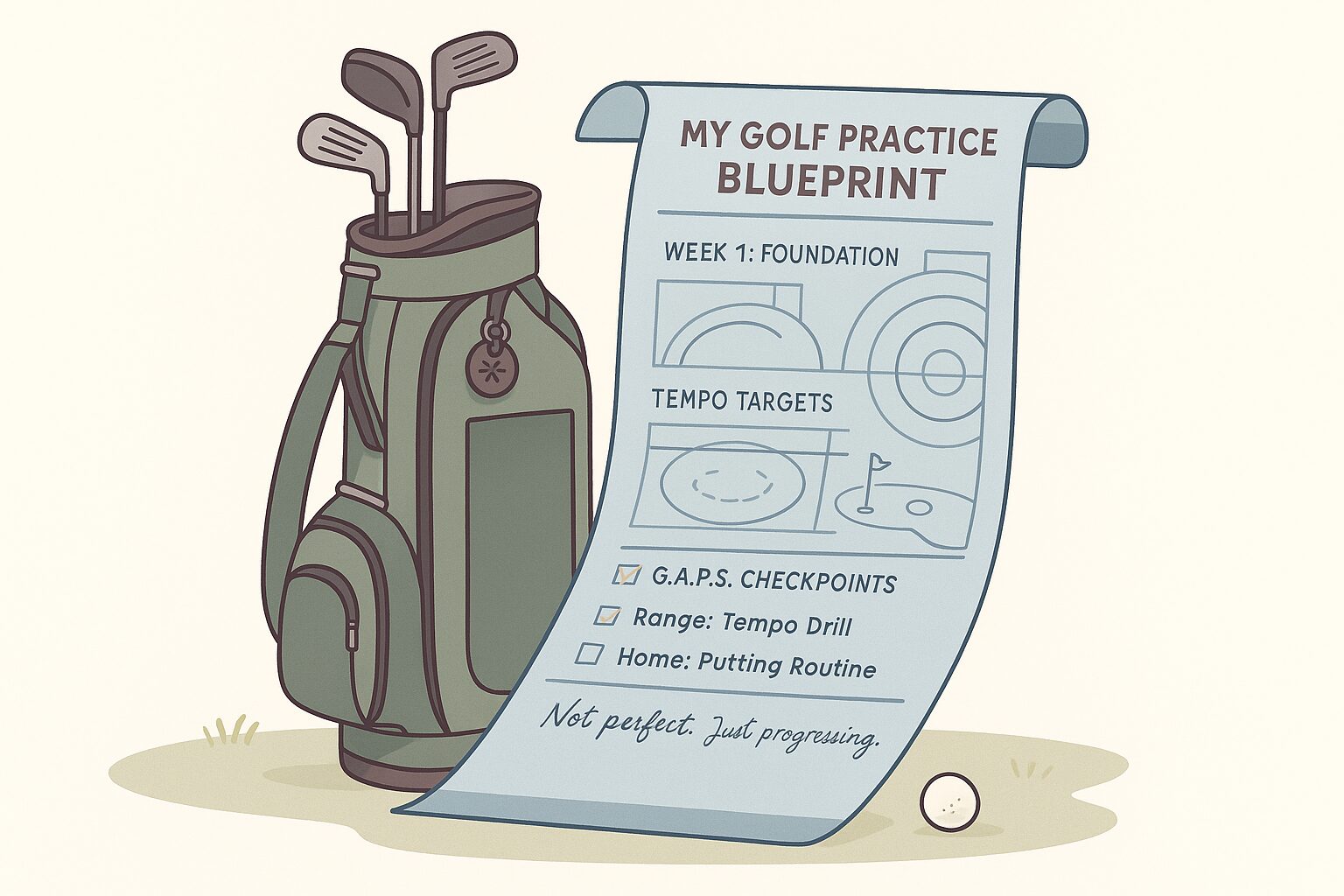
Intentional practice for the mildly competitive, chronically curious, non-professional golfer.
Why I Built a Framework
At first, my “practice” looked a lot like loitering at the range with a bucket of balls and a few too many YouTube tabs open.
I’d just decided—after binge-watching a few PGA Tour rounds—that I was going to give golf another shot. Twenty years after walking away from the game, I stumbled across a deal on Facebook Marketplace: a full set of high-end beginner-friendly clubs for $350, originally worth over two grand. Obviously, I took it as a sign.
Before my first lesson, I didn’t want to show up completely cold. So I hit the range on my own. To my surprise, my swing came back faster than expected. Not perfect—more like a backswing powered by good intentions and mild panic—but it was something. Encouraged, I kept going. More solo range sessions. More notes on what felt off. More social media tips promising to fix everything.
And that’s when the confusion started.
Some days felt amazing. Others felt like I’d never swung a club in my life. The more I tried to “fix” my swing with reels and quick tips, the more scrambled it all got. I didn’t have a plan. I had fragments of other people’s plans, all fighting for attention in my brain.
Eventually, I realized: I didn’t need more advice. I needed structure. Something flexible but focused. Something that fit my life and made space for real progress—not just random reps and rabbit holes.
So I built a weekly framework that keeps my practice sessions intentional, my progress trackable, and my golf swing… now featuring fewer crisis twitches and more actual checkpoints.
🗓️ What Every Week Needs
Foundations
Routines, body, and mindset are the base layer for everything else.
I use this time to stretch, reflect, breathe, and rebuild confidence before chasing more dramatic progress.
Finesse
This is where scoring starts—inside 100 yards.
I focus on touch, tempo, and first-chip success so I’m not scrambling (or spiraling) around every green.
firepower
The big swings: irons, woods, and the mechanics behind them.
My goal isn’t just distance—it’s reliable contact under pressure, not just in drills but in motion.
function
Where it all gets tested: league rounds, sim play, or on-course fun.
I use these sessions to apply what I’ve practiced and learn what still needs work.
This isn’t a rigid checklist. It’s more like making sure each core “ingredient” gets into the week somehow. If I can do all four? Amazing. If I can do two or three? Still solid.
If I can do all four? Amazing. If I can do two or three? Still solid.
⛳ How My Range Sessions Are Structured
Each range session is 90 minutes, broken into:
25 minutes at the start to get touch, tempo, and control dialed in.
Partial wedges, chips, and bump-and-runs to prime finesse and confidence.
I always putt before hitting full shots to train pace and intention.
This 20-minute segment includes tempo drills, start-line reps, and pressure putts.
The last 45 minutes are for irons, hybrids, and woods with a clear plan.
I work through drills, target changes, and finish with pressure-focused reps.
This mix helps me stay sharp across all areas and keeps each session purposeful. No “zombie range mode.”
Starting with finesse work forces me to slow down. It gets me in tune with my feel, my tempo, and how the ball is reacting that day. I’m not just warming up—I’m sharpening the parts of my game that fall apart fastest under pressure.
Putting early might seem backwards, but it works for me. I’m fresher, I focus better, and I don’t rush through it (or skip it entirely) like I do when I’m tired at the end. It also helps me carry feel and rhythm into the rest of the session.
Saving full swing for last keeps me from jumping straight into “let’s fix the driver” mode. By the time I get to that 50-minute block, I’m more connected to my tempo, warmed up for power, and thinking more clearly. It’s where I build consistency—but only after I’ve built awareness.
This structure doesn’t just help me stay focused. It helps me leave the range knowing what I accomplished, what still needs work, and what’s actually improving.
🏠 My Daily Putting Routine
I putt in my living room every day—usually for about 10 to 15 minutes. It’s rarely glamorous, but it’s consistent, and it fits easily into my mornings while I wait for the coffee to finish brewing.
Sometimes it’s alignment drills. Sometimes it’s pace control or short-pressure putts. But no matter what, I roll a few every day—even when it’s raining, freezing, or I’ve got five minutes and a floor that isn’t level.
It’s not fancy, but it’s foundational. And it means I’m practicing one of the most important parts of my game, even when the rest of the day doesn’t cooperate.
➡️ Here’s the putting mat and routine I use most often.
The Practice Plan Framework
Step 1: Set a Primary Focus
This is the theme of the week—the skill I most want to improve or reinforce right now.
Sometimes it’s technical (like center contact).
Sometimes it’s strategic (like gapping wedges).
Sometimes it’s mental (like trusting my swing under pressure).
I pick one, then build everything else around it.
Step 2: Add 1–2 Support Skills
Once I’ve got my main focus, I layer in a few supporting goals. Usually these are things that naturally pair well with the main theme—or that I’ve been neglecting.
If my primary focus is swing path, I might add setup and alignment checks.
If it’s chipping, I might pair that with feel-based putting.
These aren’t the stars of the show, but they help build context and momentum.
Step 3: Schedule Play + Reflection
I don’t just practice—I play. And I reflect.
That means:
- At least one 9-hole round (league or solo).
I always play in my Fellows Creek league on Monday nights. Most weeks, I also play on Thursday mornings at the University of Michigan Golf Course with the University Women’s Golf Club League. - One lesson or clinic most weeks.
I usually work this into a Thursday evening, depending on what’s available. Sometimes it’s a group session, sometimes a private check-in—either way, it’s a dedicated hour to learn and recalibrate. - 15–20 minutes post-round to review stats + jot notes.
(What worked, what didn’t, what needs work.) - A quick end-of-week check-in to assess progress and reset for next week.
It’s not just about how many balls I hit.
It’s about what I learn when I do.
Monthly Themes + Weekly Focus Plan
I don’t just wing it week to week — I plan in four-week cycles with a central monthly theme that aligns with my goals for the season.
Each month is broken into focused weeks, so I’m always building one layer at a time. Here’s how it looks:
🟣 Month 1: Contact + Clean Strikes
- Week 1: Getting Into the Swing
Re-establishing routines, swing feel, and consistent contact. - Week 2: Pre-Shot Routine + Tempo
Locking in sequencing and calming my setup. - Week 3: Contact + Club Path
Center-face strikes and club delivery drills. - Week 4: Visual Focus + Intermediate Targets
Improving consistency through better aim and alignment.
🟢 Month 2: Distance Control + Scoring
- Week 5: Wedge Gapping + Scoring Zones
Dialing in distances inside 100 yards. - Week 6: Uphill, Downhill, and Uneven Lies
Handling real-world terrain and controlling trajectory. - Week 7: First Chip Success + Sand Practice
Limiting mistakes around the green. - Week 8: Par-Saver Practice + Recovery Shots
Making smarter second shots after mistakes.
🔵 Month 3: Pressure Practice + Performance
- Week 9: Pressure Putting + Pre-Shot Routine
Reinforcing trust under stress. - Week 10: Simulated Rounds + Target Play
Creating competitive practice environments. - Week 11: Mid-Round Reset + Mental Tags
Improving focus hole by hole. - Week 12: Club Confidence Challenge
Tracking and improving performance by club.
🟡 Month 4: Strategy + Scoring Efficiency
- Week 13: Scoring Strategy + Strengths Map
Using what works — smarter decisions, fewer mistakes. - Week 14: Avoiding Hero Shots + Playing Smart
Taking the high-percentage play every time. - Week 15: Lag Putting + Second-Chance Drills
Fewer three-putts, better recovery focus. - Week 16: Tournament Prep + Calm Execution
Locking it all in and trusting the plan.
Sample Practice Week
|
Day |
Practice Type |
Focus |
|---|---|---|
|
Monday |
League Round |
Application + Shot Strategy |
|
Tuesday |
Range Practice |
Swing Path + Setup Alignment |
|
Wednesday |
Backyard Short Game |
BLT Chipping + Ladder Drill |
|
Thursday |
League Round + Clinic |
Routine Focus + Lesson Integration |
|
Friday |
Backyard Short Game |
First Chip Success + Wedge Matrix |
|
Saturday |
Range Practice |
Fairway Woods + Contact Drills |
|
Sunday |
Practice Round |
Full Routine + Scoring Zones |
Make It Yours
Your game might need different ingredients. Your week might look totally different.
That’s the point.
This framework isn’t about fitting my schedule—it’s about fitting your priorities. One primary focus. A couple supporting skills. Some time to play and reflect. Rinse. Repeat. Revise.
It won’t always be perfect. But it’ll always be progress.