
A setup system for recreational golfers who want fewer swing thoughts, straighter shots, and a little peace over the ball.
I used to stand over the ball and think: What am I even doing here?
Not existentially. (Well, sometimes.) But mostly: What am I doing with this club, right now, in this stance, on this lie? Because one shot would go dead straight. The next? Left of left. And I couldn’t tell you what changed between them.
Turns out the answer wasn’t “fix my swing.” It was: start with a better setup.
And that’s where G.A.P.S. came in.
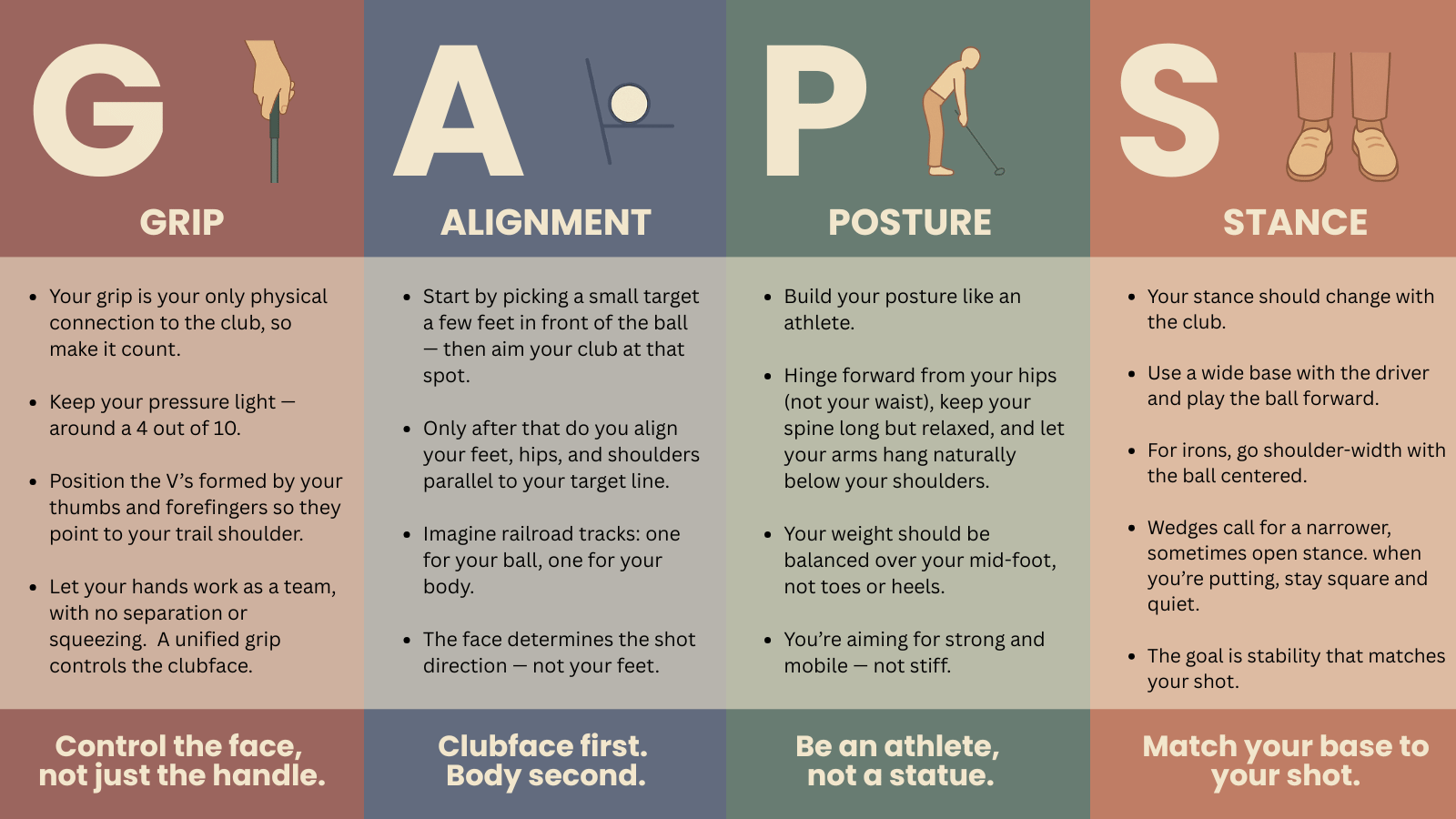
It’s a simple, four-step setup routine I now use before every shot — driver to putter. No extra swing thoughts. No spiraling. Just four things, in order:
Grip. Alignment. Posture. Stance.
Four seconds. Four checkpoints. One steady foundation for whatever happens next.
📃 Where I Learned G.A.P.S. — and Why I Trust this Setup System for Recreational Golfers
I didn’t make it up. I learned it from Kathy Kowalczyk at Kowality Golf. Kathy introduced it to me as a way to get set up — physically and mentally — with clarity and confidence.
Later I found out that the method was originally developed by PGA pro Rich Scott, who coined the G.A.P.S. acronym at Fox Run Golf Club as a way to teach consistent setup to students of all levels. Golf media, professional instructors, and performance researchers have all confirmed the same thing: it works.
And the reason it stuck with me? It gave me something I could actually repeat. On the tee. In the rough. Over a chip. Standing over a par putt.
🔤 G.A.P.S. — A Real Setup Routine for Real Golfers
This isn’t a swing tip. It’s what I do before the swing, so I don’t have to overthink during it.
G — Grip
Your grip is the only physical connection between you and the club. I used to grab the handle however it felt comfortable that day. Now? I do a 5-second grip check every time.
- Grip pressure around a 4 out of 10
- V’s from thumbs and forefingers pointing to the trail shoulder
- Hands working together — no squeeze, no separation
- Putting: same idea, just softer and calmer
When my grip’s wrong, my clubface is chaos. When it’s right, I can trust the club to do its job.
According to Titleist, grip issues are a leading cause of directional misses and poor face control.
A — Alignment
My old routine? Align my feet, then hope the clubface matched. That got me a lot of pulled shots and confused stares.
Now I:
- Pick a small intermediate target
- Set the clubface to that first
- Align feet, hips, shoulders parallel to that line
I visualize a railroad track: one rail for the ball, one for my body.
“If the face isn’t aimed right, the ball’s not going where you want — no matter how good your swing feels.”
This method is backed by Chris Ryan Golf and Golf.com.
P — Posture
When I set up well, I feel like an athlete. When I don’t? I feel like I’m about to trip over the ball.
- Hinge from hips, not waist
- Spine long but natural
- Arms hang softly
- Feet balanced through mid-foot
“Think shortstop, not statue.”
Free Online Golf Tips and Swing Align emphasize posture as a foundation for tempo, power, and swing path.
S — Stance
Stance felt like an afterthought to me. But it’s the base for everything that follows.
- Driver: wide, ball forward
- Fairway woods: slightly narrower
- Irons: shoulder-width, ball center
- Wedges: narrow, sometimes open
- Putting: quiet, square, stable
“Your stance controls your foundation. Get it right, and you’ve got a shot. Get it wrong, and you’re just improvising.”
Stix Golf and Golf.com both validate stance as a key performance factor.
🧠 G.A.P.S. vs. G.R.A.C.E. — Planning vs. Positioning
You might already know about my G.R.A.C.E. routine — the mental pre-shot plan I use before every swing. (If not, read it here.)
- G.R.A.C.E. helps me decide what shot to hit: Gather info, Route the plan, Approach the ball, Commit to setup, Execute.
- G.A.P.S. is what I do during that third step — Approach the Ball.
Once I’ve made my decision, G.A.P.S. kicks in to handle the physical setup:
Grip. Alignment. Posture. Stance.
It’s how I get my body ready to match my mind.
G.R.A.C.E. is strategy.
G.A.P.S. is structure.
🏆 How I Use G.A.P.S. Across the Bag
| Club Type | Setup Emphasis |
|---|---|
| Driver | Light grip, wide stance, posture |
| Long Irons | Alignment, posture, ball position |
| Wedges | Narrow stance, tempo cues |
| Chipping | Balance, slightly open stance |
| Putting | Soft grip, square stance, stable |
No matter what club I’m holding, I run through G.A.P.S. It gives me something to do instead of overthink.
⏳ Learning Curve: It Becomes Automatic
Most research says it takes:
- 2–3 sessions to memorize a setup routine
- 3–4 weeks to make it feel natural
- 6–8 rounds to see measurable improvement
Source: Wicked Smart Golf
That matched my experience exactly. Week one felt clunky. By week two, I was checking alignment without thinking. And now? I never address the ball without running through G.A.P.S.
🚀 Want to Try This Setup System for Recreational Golfers? Start Here:
- Practice it at the range for a week
- Use a mirror or alignment sticks if you have them
- Pair it with G.R.A.C.E. for shot planning
- Keep it short (under 8 seconds is ideal)
- Don’t aim for perfect. Aim for repeatable
And if you need a visual? I’ve got a downloadable G.A.P.S. Routine Card coming soon.
🔁 Final Thought
Some golfers chase swing tips. I’m chasing repeatable foundations.
G.A.P.S. is the one that finally stuck. It’s simple, fast, and repeatable under pressure. And it gives me a chance to start every shot from a place of balance instead of guesswork.
Start with your grip. Align the club. Set your posture. Lock in your stance.
Then swing with whatever you’ve got that day. At least now, you’ll know where it started.
References: