
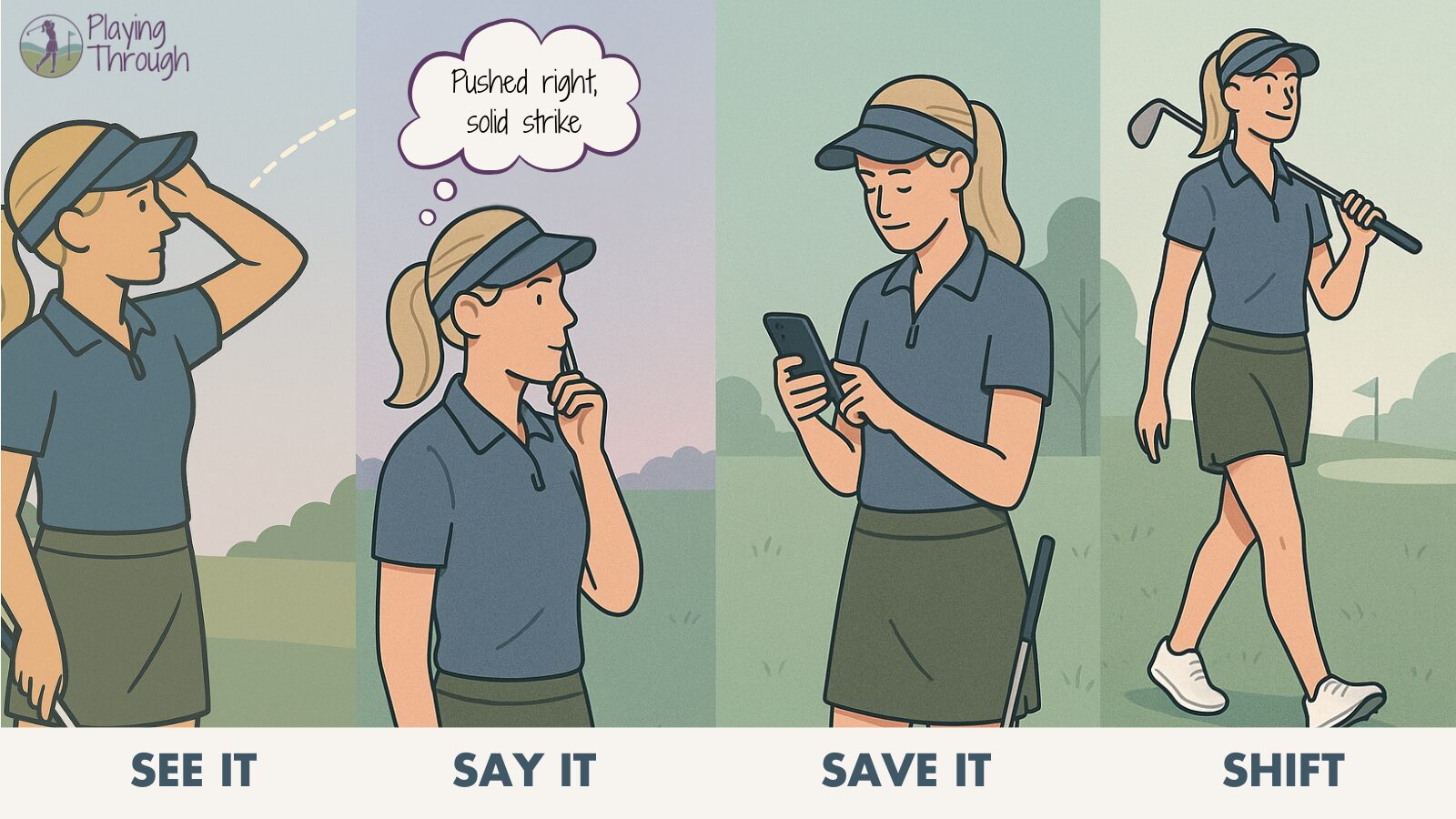
Even after the ball’s in the air, your job as a golfer isn’t done. In fact, how you respond in the seconds after a shot might matter just as much as how you swung the club. And according to the PGA, one of the best ways to prepare for that next shot — whether you just hit a beauty or a total mess — is by using a consistent golf post-shot routine.
The most important shot in golf is the next one.
Lee Trevino
Why a Golf Post-Shot Routine Matters
Every shot tells a story — and not just the good ones.
If you’ve been following along my Playing Through journey, you know I’ve been deep in the process of refining not just my swing, but the way I approach the game mentally. And one of the biggest breakthroughs hasn’t come at address — it’s come after the ball is in the air.
Golf is not a game of perfect.
Dr. Bob Rotella
Rotella’s mental game advice has shaped how I approach golf beyond just mechanics — especially when things don’t go as planned. I listened to Golf Is Not a Game of Perfect on audiobook earlier this season, and honestly? It changed the way I think about the game. Rotella’s framing of the mental side gave me permission to stop chasing perfection — and start building habits that actually help me play through.
This is my post-shot routine:
See it. Say it. Save it. Shift.
It’s simple. It’s repeatable. And it’s helping me turn every shot — whether it’s piped or penalized — into an opportunity to learn, reset, and move forward with clarity.
So let’s walk through it. And yes — there will be stories.
🔄 4-Step Post-Shot Routine
👀 1. See It
Watch the full ball flight. Really see it.
Not just the destination, but the story it tells: the shape, the contact, the bounce.
This isn’t about judgment — it’s about observation.
Detached, curious, honest.
Sometimes that’s “Right on line, soft draw, nice rollout.”
Sometimes it’s “Low bullet, hard right, bounced into the abyss.”
Either way: note it.
🗣️ 2. Say It
Give the shot a name — mentally or out loud.
This is the cognitive bridge between reaction and reflection. You’re creating a pattern of neutral feedback.
- “Pulled it left, but clean contact.”
- “Topped it — rushed the takeaway.”
- “That’s the fade I rehearsed.”
Facts, not feelings.
This isn’t the moment for “Why do I even play this game?” or “I should just go home and pull out the emergency pint of Ben and Jerry’s.”
(Although I’ve definitely said both. Loudly.)
📂 3. Save It
If it was a good shot — lock it in.
I had a moment a few weeks ago where I absolutely crushed a drive. 215 yards, dead straight, center-cut fairway. Honestly? I didn’t think I had that in me yet. But I did — and I saw it. I heard my playing partners say things like “Wow” and “That’ll work”—and for once, it wasn’t sarcastic, consoling, or lightly patronizing. It was genuine, and it felt really good to let that moment land.
So I took a breath. I made a quick note. I made a mental snapshot of the feel in my hands and the rhythm of the swing. I should’ve taken a picture, too. (Next time.)
Now if it’s a miss — and believe me, I’ve got those too — this is the time to rehearse the fix.
Make a slow-motion swing with the move you meant to make. Store that instead.
♻️ 4. Shift
Let it go. Seriously. Move on.
This is the step I’ve had to work the hardest on — because after that 215-yard bomb, I got way too in my head. The next shot? A short iron that I tried way too hard to perfect. I started thinking, “Don’t mess this up” instead of “Just play the shot.” I ended up blocking it into a penalty area. Oops.
That moment taught me the value of this last step.
Shift is about emotional reset.
- Breathe.
- Glove tap.
- Shake it off.
- Walk with intention.
As someone who uses cognitive behavioral therapy tools in real life, I’ve found that “Shift” pairs beautifully with the CBT principle of Catch the Thought — recognize an intrusive or spiraling thought, name it, and move on.
“CBT teaches you to catch the thought, name it, and shift it — without spiraling.”
— Verywell Mind
That’s exactly what the final ‘Shift’ step is for. Resetting mentally after a shot keeps my next one clear and uncluttered.
You can’t carry your last shot into your next one. That’s a recipe for doubt — or worse, overconfidence. (Check out this Beyond the Scorecard post for proof: My Messiest Round of Golf — and Why I’m Glad I Played It.)
🧹 Where This Fits
This post-shot routine is a mental follow-through. It connects your current swing to your overall game plan. It keeps you honest, curious, and focused on progress — not just results.
It also ties directly into your pre-shot routine — I use these ones:
- G.R.A.C.E. (for full swings)
- or Look. Feel. Align. Glide. (for short game shots)
One leads into the other. You finish the shot, you learn what you can, and you walk into the next one with clarity.
🏉 Try a Golf Post-Shot Routine Yourself
Pick a few holes in your next round. Use this routine every time. Make it a game-within-the-game. Bonus points if you write down a couple of “Save It” moments at the end.
With repetition, this becomes second nature — and once it does, your mind becomes less crowded, your body more consistent, and your round a whole lot more resilient.
You don’t need to play perfect golf. But you do need a system to respond to imperfect golf.
Coming Soon: I’ll add a visual routine card here you can download or screenshot.
Let me know in the comments or on Instagram if you’ve tried this or have your own routine. And if you ever break your distance record with a fairway laser, please take the picture. For both of us.
🧠 The Mental Reset Is the Real Skill
Getting your mechanics right is important — but the real difference-maker? It’s how you think after you swing.
LPGA champion Nelly Korda has talked openly about how sports psychology reshaped her game. She doesn’t just swing confidently — she recovers confidently. After a bad shot, she stays composed, resets quickly, and lets it go.
“I’ve worked really hard on the mental side of my game — that’s what helped me win.”
— Nelly Korda on sports psychology and focus
That’s what the post-shot routine is really about: managing the space between shots. That space can be full of tension, pressure, or rumination — unless you train it to hold something else.
Mental game experts agree: success in golf isn’t just about what your body does — it’s about what your brain thinks. Sports Psychology Today breaks it down clearly: “Golf is a mental game, especially at the higher levels.”
Mentally tough golfers recover faster, stay calm under pressure, and let go of bad shots more efficiently. That’s not magic — that’s a trainable skill.
One of the coolest insights I’ve seen came from a TPI performance study with the UCLA golf team. Athletes trained with neurofeedback — essentially, brain pattern reshaping — showed measurable improvements in focus and scoring:
“Athletes trained with neurofeedback showed a 12% increase in greens-in-regulation and a 9.7% reduction in 3-putts.”
In other words, how you respond to shots matters just as much as how you hit them. Your brain will keep running old patterns unless you give it something new — and that’s exactly what a post-shot routine offers.
See the shot. Say what happened. Save what matters. Then Shift.
Repeat it. Own it. And let your brain start learning how to play through.