
One week, three rounds, four practices, and a rhythm that’s actually moving the needle.
“You’re practicing too much.” — my playing partner, skeptical
“Most people just play more. Why complicate it?” — same guy, doubling down
But here’s the thing: “just playing more” doesn’t lead to real improvement. Not for adult golfers. Not if you’re trying to break 100 — or chase 90.
So I built a rhythm. It’s a weekly golf practice plan that adapts and adjusts according to my life, my progress, and my goals.
I used to call it 7-4-3-1 — a shorthand for how many days, practices, and rounds I fit in each week. But what it really is, is my improvement loop. It’s flexible, structured, and it’s finally helping me get better on purpose.
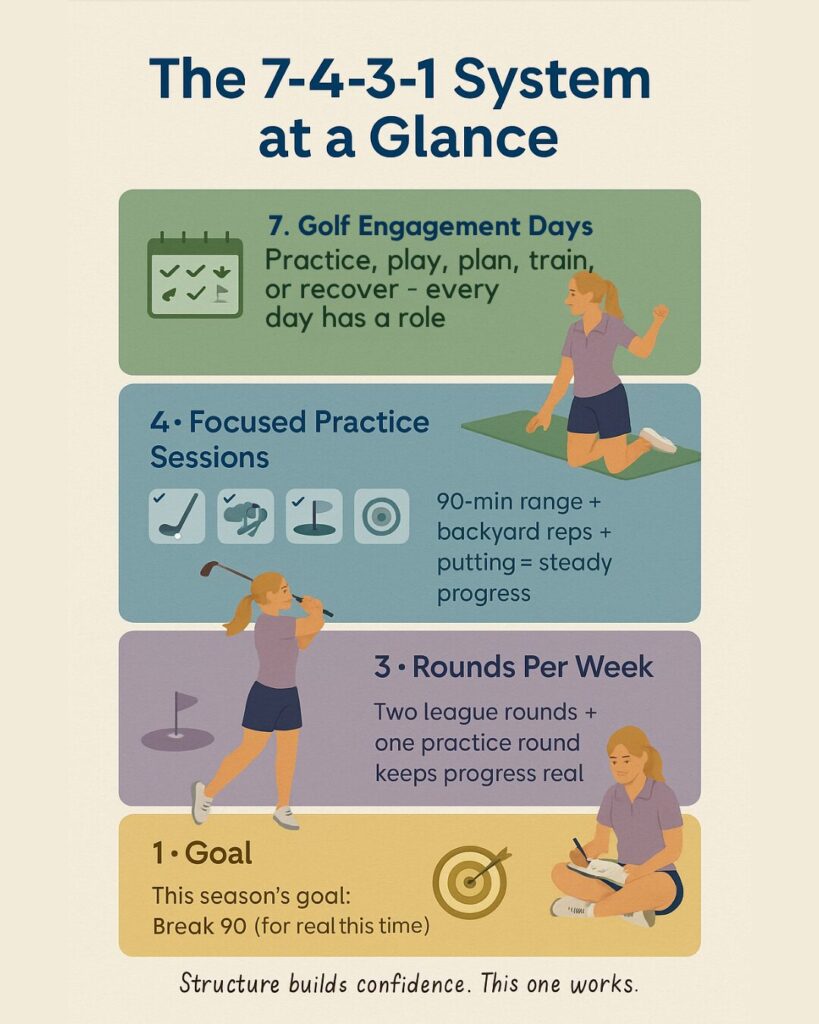
This an improvement loop that actually works for me — flexible enough to fit into real life, routine enough to get results. The backbone: seven days of golf activity, four structured practices, three rounds, and one focused goal.
After just one month of consistent effort, my 9-hole average dropped from 56.7 to 51. I saw improvements in penalties, fairways hit, greens in regulation, and first chip success. Even better? I know why it’s improving — and what to do next.
If you’ve ever wondered whether practice can actually move the needle, here’s how I’ve made it work without burning out or giving up.
Why Random Practice Fails (Especially for Adults)
Let’s be honest — most of us start with this routine:
- Hit the range when there’s time
- Smash driver until it feels good
- Chip a few balls
- Leave feeling productive
But repetition isn’t the same as improvement.
Dr. Anders Ericsson (the father of deliberate practice) and his co-authors explained that real improvement happens when practice includes feedback, intentional difficulty, and focused goals — not just repetition.
The PGA Teaching & Coaching Summit backs this up too: recreational golfers who use structured practice improve up to 40% faster than those who don’t.
And that’s before we even get into the fact that as adult learners, we need a why.
Malcolm Knowles laid this out in his work on adult learning theory:
- Adults need to know why they’re doing something
- We want immediate, practical application
- We learn best when we direct and reflect on our own progress
That’s exactly what this rhythm gives me.
The Golf Improvement Loop (How My Week Works)
Every day doesn’t have to mean a full round. But it does mean engaging intentionally.
📅 Weekly Rhythm Breakdown:
- 7 days: Golf activity or planning every day (practice, play, reflection, or mobility)
- 4 practices: Core skill sessions (short game, full swing, pressure drills, and putting)
- 3 rounds: Two league rounds + one flexible practice round
- 1 goal: Right now, that’s breaking 90 by fall
“Structure builds confidence. This one works.”
⛳ Weekly Schedule At a Glance
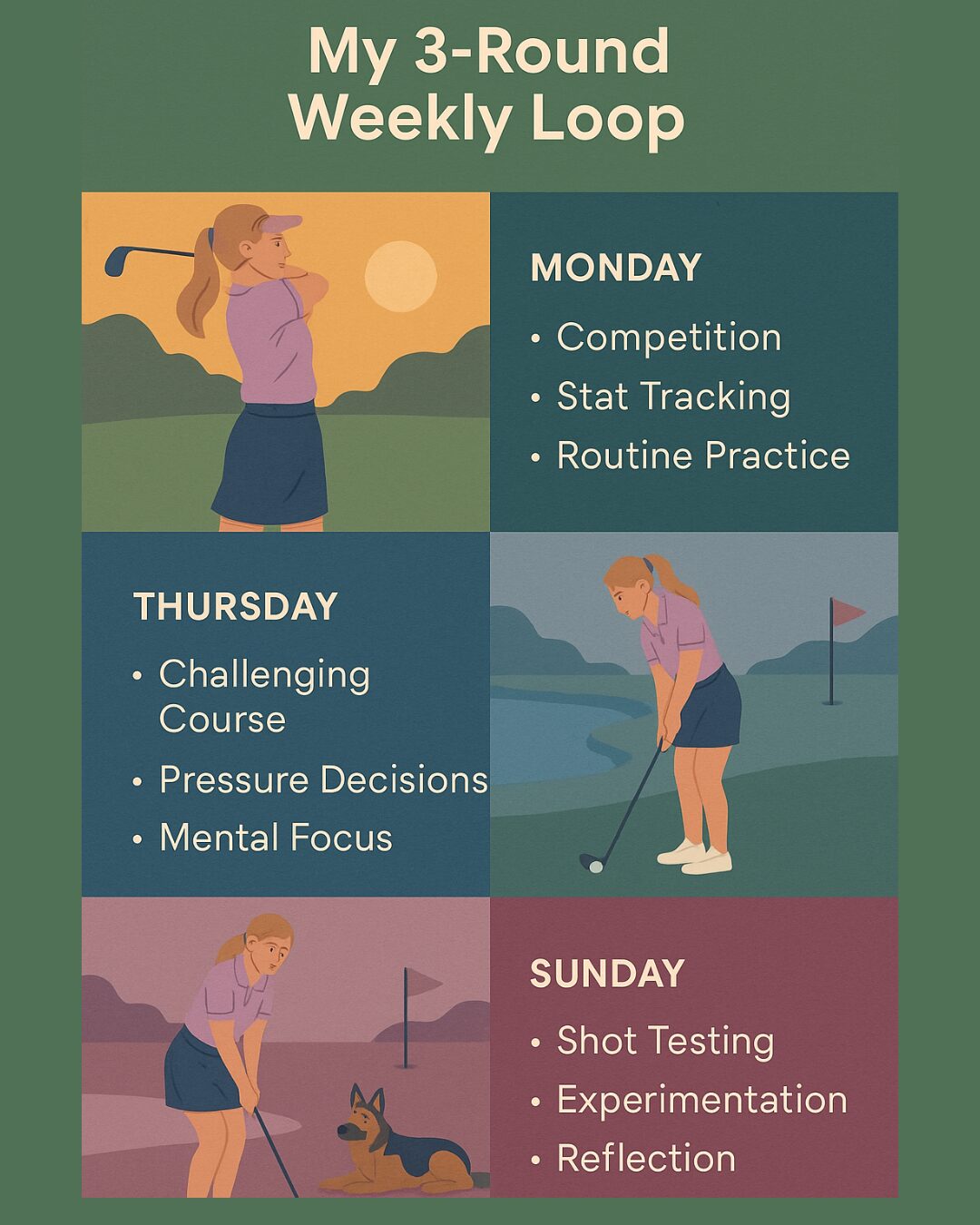
Sunday: Practice Round + Stats Review
Monday: Fellows Creek League Round
Tuesday: Range Practice (Long Game)
Wednesday: Backyard Practice (Target + Pressure)
Thursday: UM Women’s League Round
Friday: Backyard or Hickory Creek Short Game
Saturday: Short Game Intensive at Carl’s Golfland
I pair these with putting every day (15 mins), mobility (GOWOD), and strength work (Fitbod app, 4x/week).
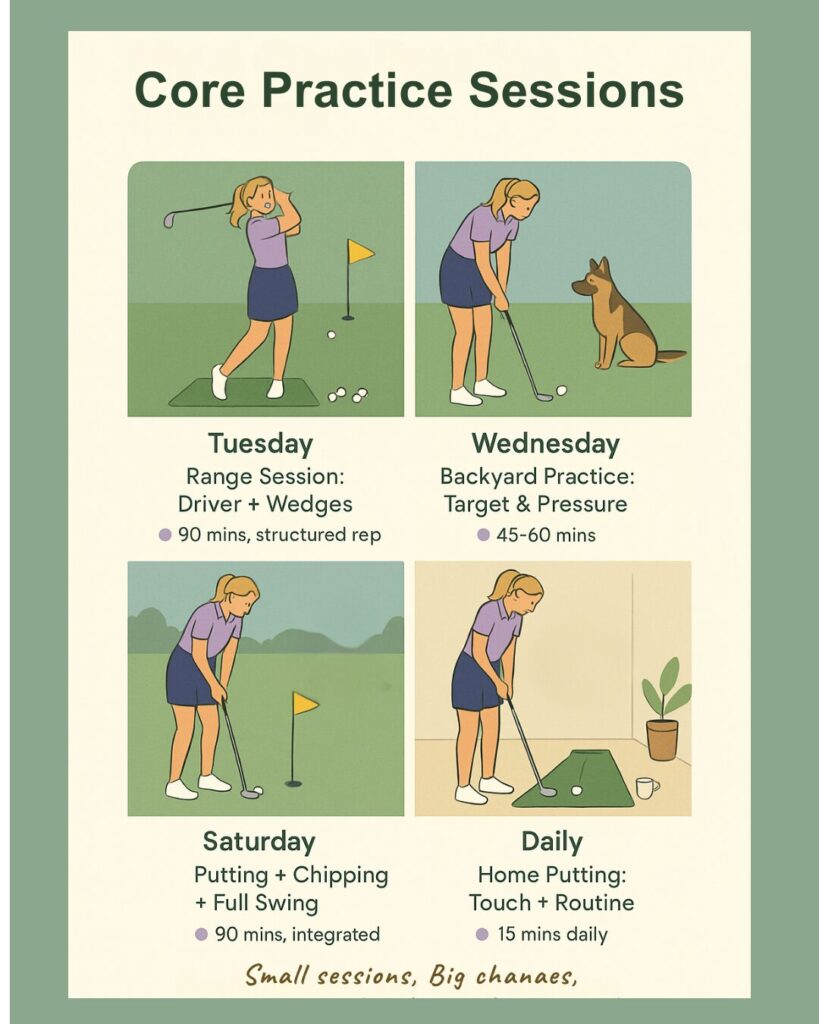
🎯 Core Practice Sessions
|
Day |
Focus |
Duration |
|---|---|---|
|
Tuesday |
Driver + Wedges (Structured Range Work) |
90 min |
|
Wednesday |
Backyard Target + Pressure |
45–60 min |
|
Saturday |
Putting, Chipping, Full Swing Integration |
90 min |
|
Daily |
Home Putting: Touch + Routine |
15 min |
“Small sessions. Big changes.”
🗓️ My Weekly Golf Practice Routine: 7 Days, 4 Practices, 3 Rounds, 1 Goal
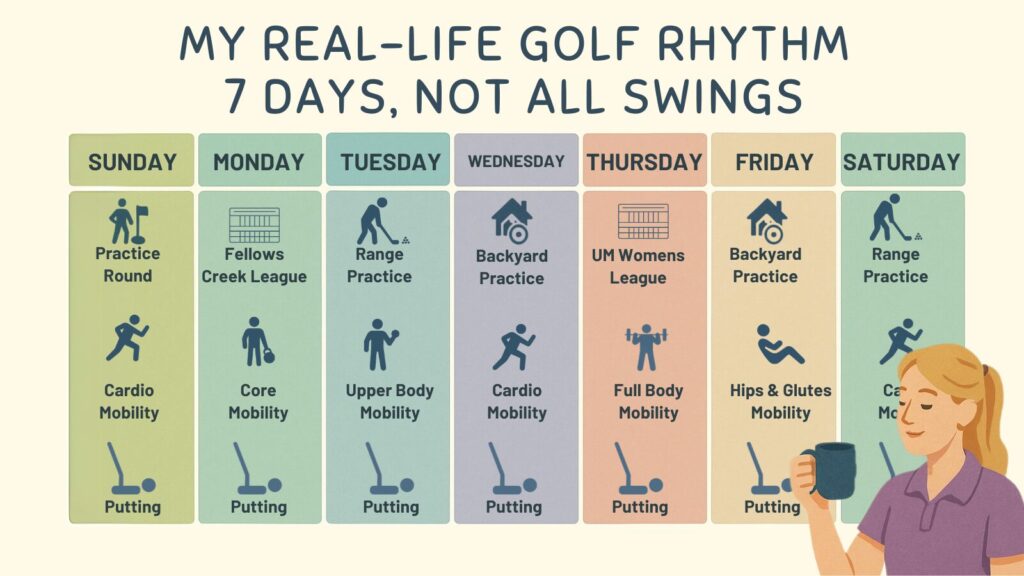
This is the weekly rhythm that’s helping me improve — a mix of practice, play, and purposeful rest. Some days get shuffled or skipped (because life), but the structure gives me a reliable baseline to return to when things go sideways.
🧱 Key Systems That Support It
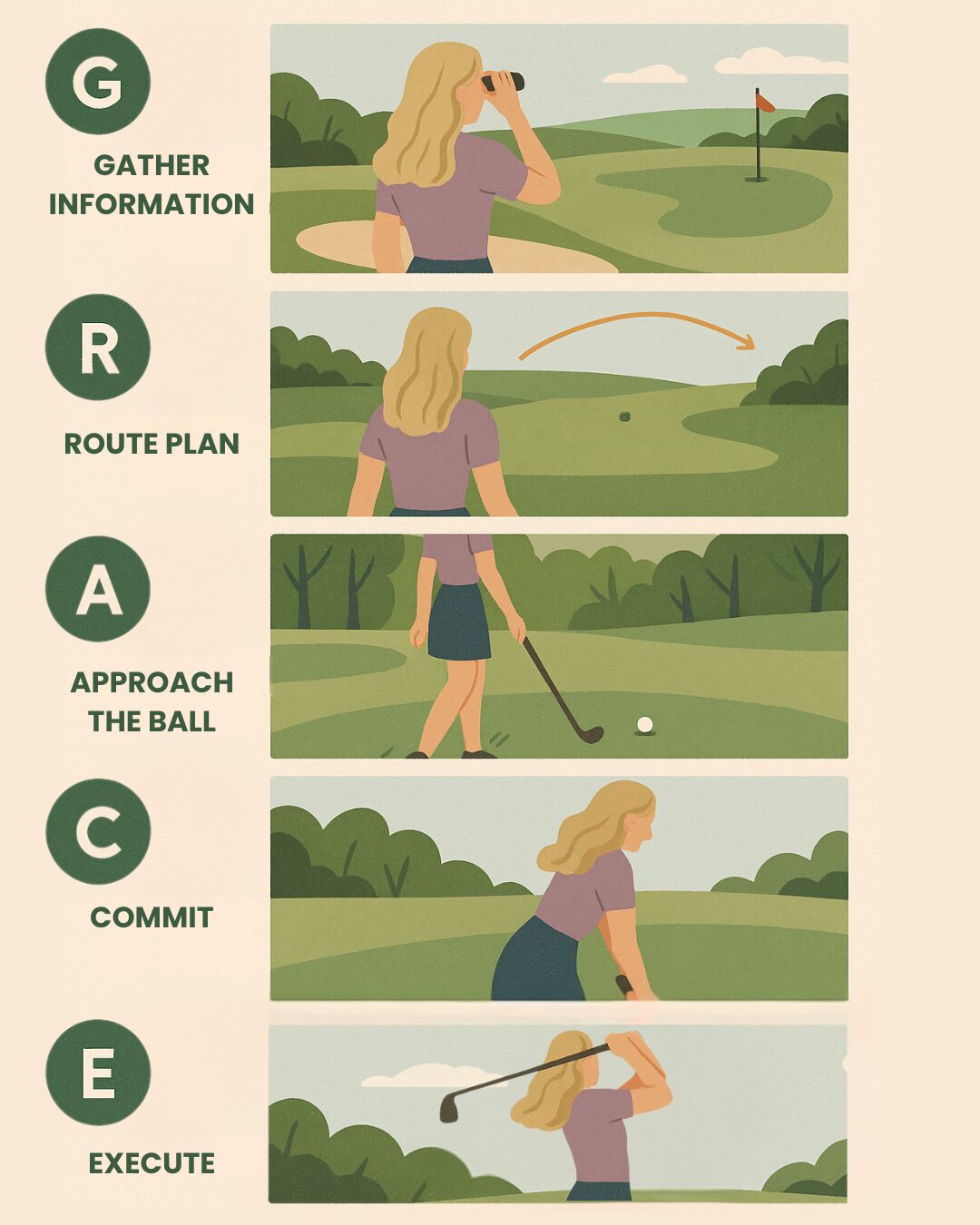
🧠 G.R.A.C.E. Pre-Shot Routine
Gather Info → Route Plan → Approach → Commit → Execute
Every ball I hit in practice — especially on Tuesdays — follows the same routine: G.R.A.C.E.
It keeps me focused, decisive, and out of my own head. I plan behind the ball, commit over it, and swing with clarity.
No second-guessing. No stalling. Just structure I can rely on — whether I’m warming up or pretending it’s Hole 4 at Fellows Creek.
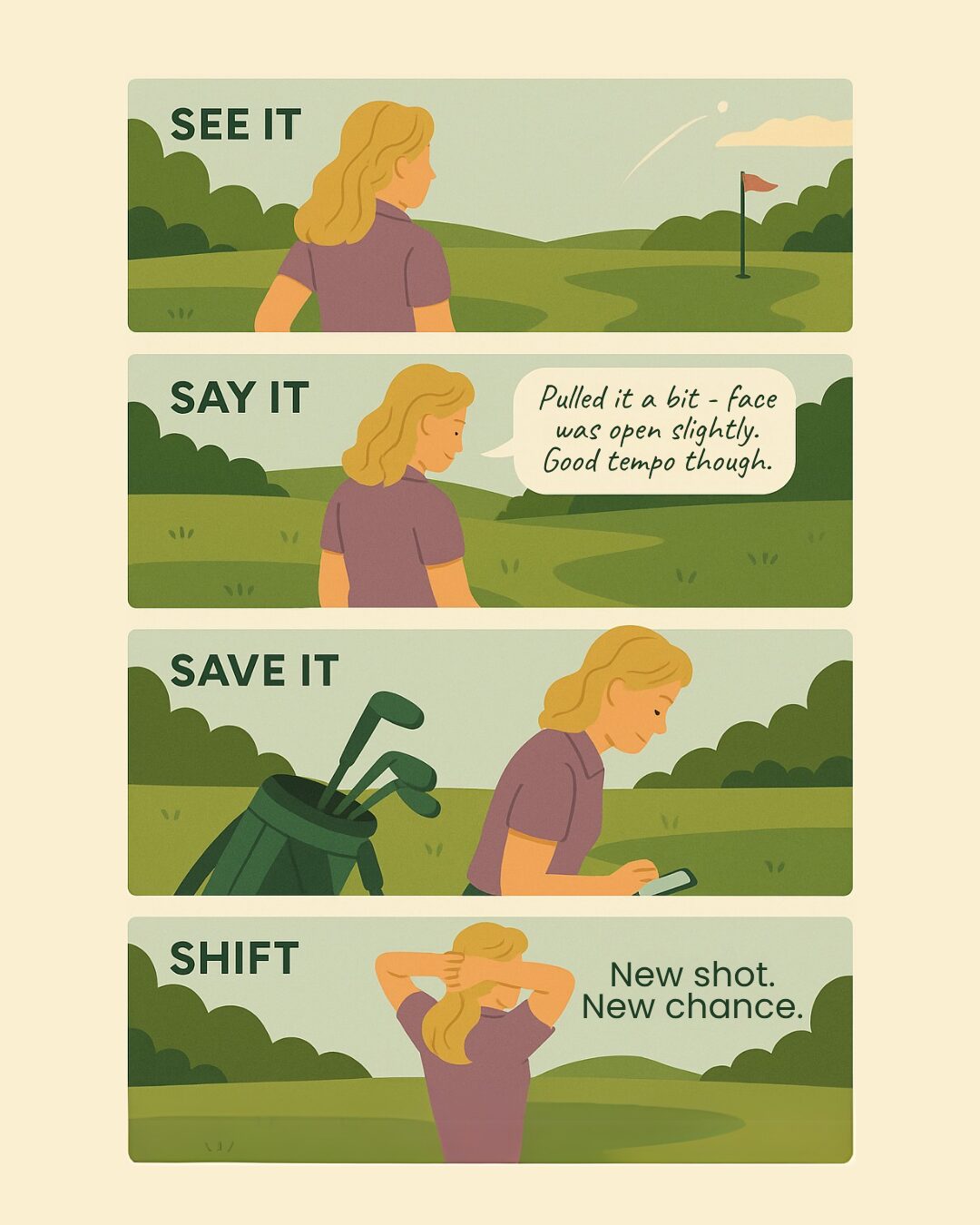
🔄 My Post-Shot Routine: Keeping the Loop Moving Forward
One of the most underrated parts of my weekly rhythm? What I do after each shot. I use a four-part post-shot routine called “See it. Say it. Save it. Shift.” It’s simple, and it helps me stay emotionally steady — especially when things don’t go as planned.
But the “Save It” step might be the most important part of the improvement loop. I quickly log what happened. Not in a dramatic, self-critical way — just a calm checkpoint. It’s the difference between reacting and reflecting. This is how I spot patterns.And it’s how I stop bringing old shots into new ones.
How I Set Up My Practice Sessions
I don’t just show up to the range and wing it anymore. Each session is designed ahead of time — not to be perfect, but to be purposeful. I’ve found that structure doesn’t make practice boring. It actually makes it more satisfying. Here’s how I build a session that fits my goals, my energy level, and the time I’ve got.

A flexible format for consistent improvement. Choose your focus, follow the flow, skip the chaos.
1. Start with My Stats
Before I ever hit a ball, I look at my 18Birdies data from my last round. What went sideways? Was I chunking wedges again? Missing left off the tee? Struggling to commit on approach shots? My stat patterns shape the focus of the week.
2. Build Around One Focus
Each session has a core theme — driver aim, wedge control, putting pace, bunker confidence. I don’t try to fix everything. I just pick a lane and stay in it.
3. Follow the Practice Menu Format
I treat practice like a meal — structured, satisfying, and not overloaded. This simple format keeps me focused without burning out.
- Warm-Up (15 min): Light swings, tempo work, or putting to ease in. No expectations — just feel and flow.
- Main Focus (30–40 min): One skill, one goal. I’ll work with targets, track results, and pay attention to patterns.
- Challenge Mode (15–30 min): I simulate real conditions — like a 9-ball up-and-down test or a 7-shot hole with consequences for mistakes.
It’s not always perfect, but this “menu” helps every session feel purposeful and progress-oriented.mplished something real.
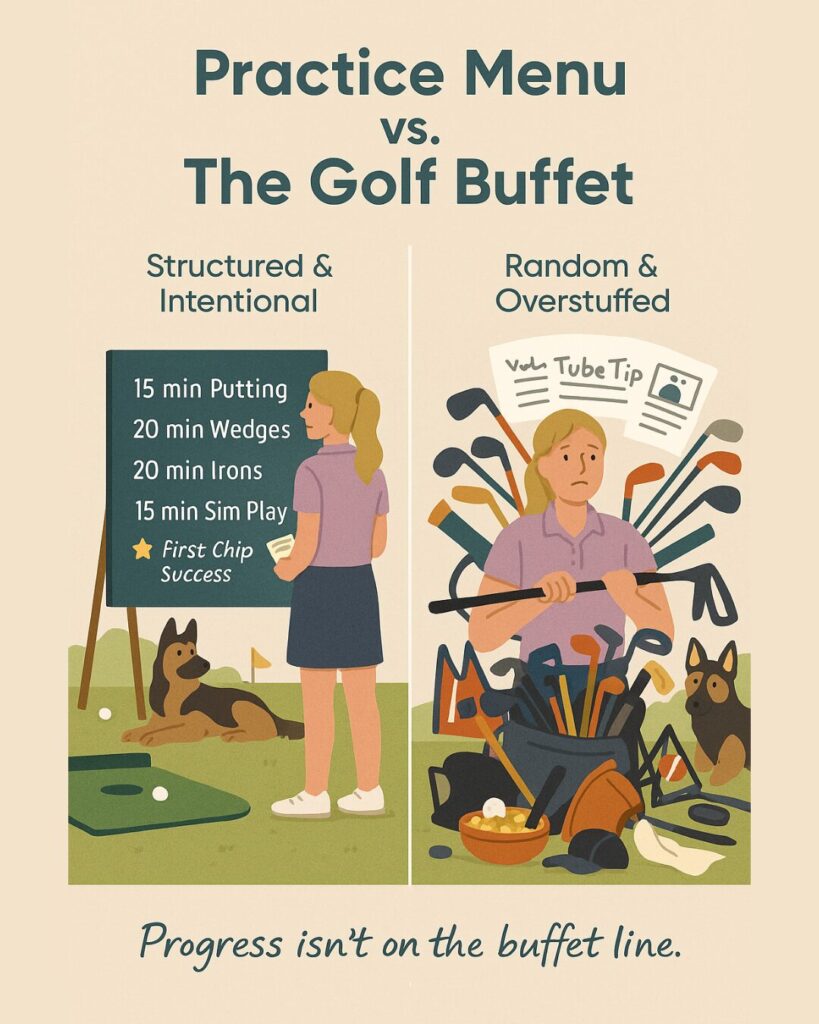
More structure. Less buffet. 
Simple drill. Real feedback. This is my go-to drill when my irons or driver are misbehaving — and it’s wildly satisfying when I get it right. 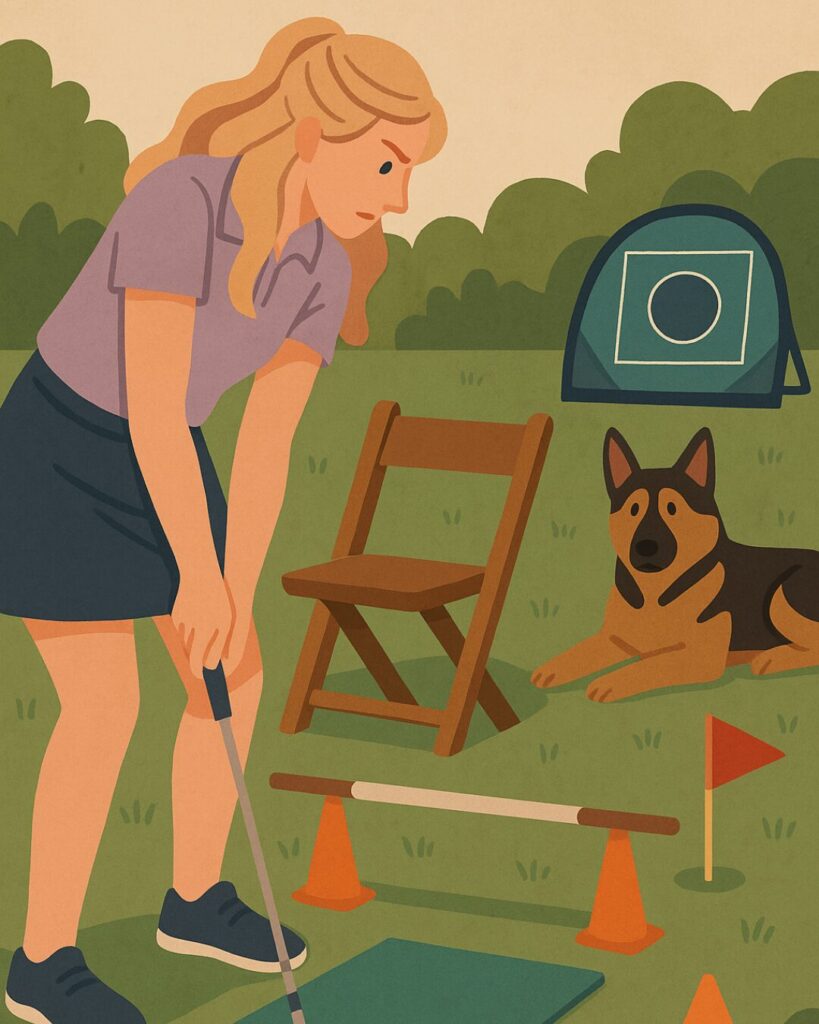
Over, under, and through — the real short game test. This is one of my favorite DIY backyard setups. It simulates on-course chaos and forces creativity around the green.
4. Take Notes
Yes, even at the range. I jot down what I’m feeling, which clubs are dialed, what adjustments worked, and anything I want to try next time. My notebook helps connect one session to the next.
5. End with Confidence
The final swing of every practice is a full routine, no tinkering. Just target, setup, go. I always end on a shot I believe in.
🔁 What If I Miss a Day?
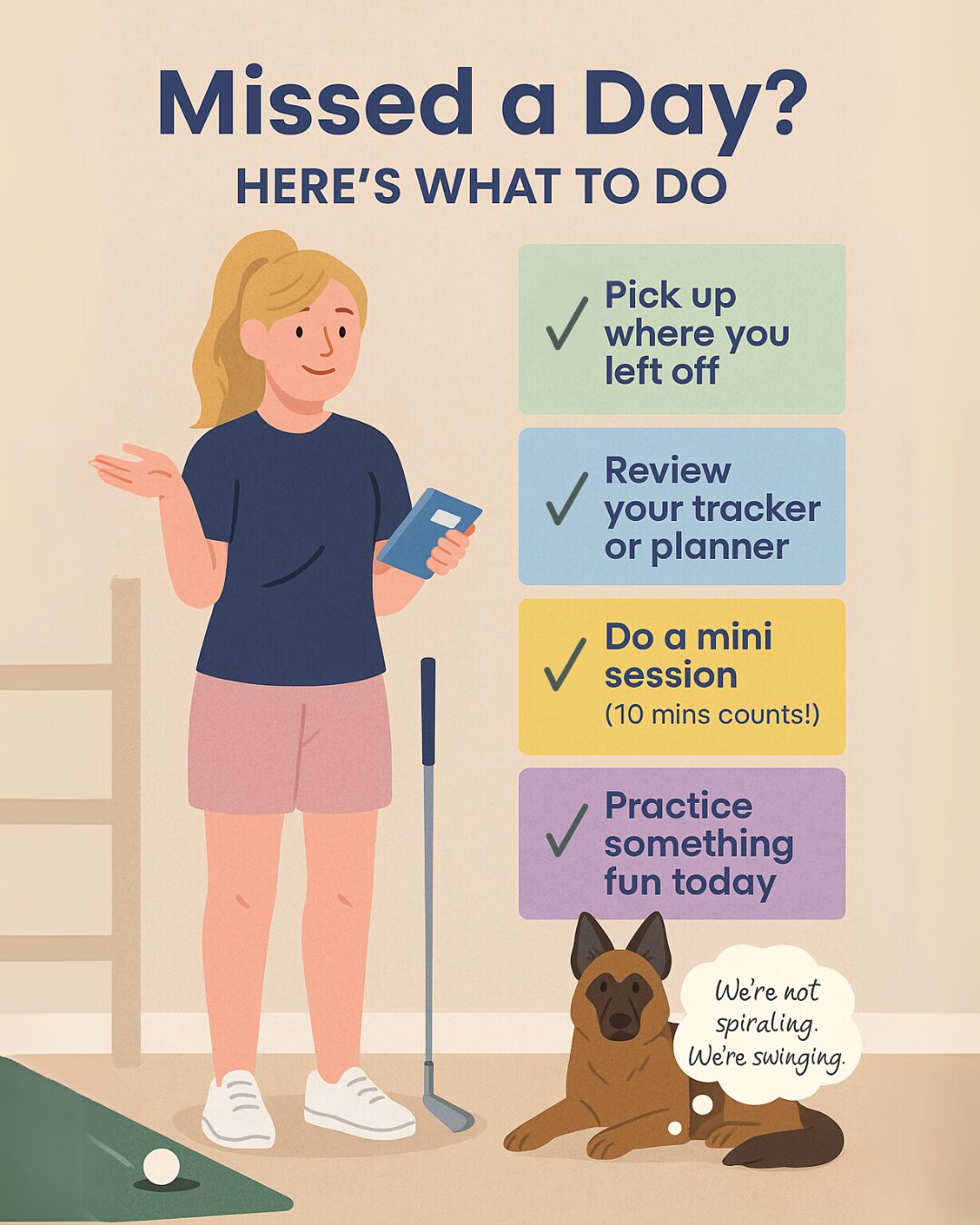
No spiraling. No guilt.
✅ Pick up where I left off
✅ Review my tracker
✅ Do a mini session (even 10 min counts)
✅ Practice something fun
It happens — work runs late, weather turns, energy tanks. I don’t panic or try to “make it up.” Instead, I zoom out.
The weekly rhythm is a loop, not a checklist. If Tuesday slips, maybe I go a little deeper on Friday. If a round gets rained out, I’ll work on tempo or review stats instead.
Progress isn’t about hitting every rep — it’s about staying in motion. And this loop makes it easy to jump back in.
🧮 One Month Results (Real Stats, Real Progress)
| Metric | Before | After | Change |
|---|---|---|---|
| Avg. Score (9 holes) | 59.7 | 51.1 | ⬇ 9.6 |
| Doubles or Worse | 5.3 | 4 | ⬇ 1.3 |
| Penalties per Round | 4.3 | 2.9 | ⬇ 1.4 |
| Fairways Hit | 51.7% | 57.1% | ⬆ 5.4% |
| GIR | 21.7% | 33.3% | ⬆ 11.6% |
| Par or Better Holes | 0.9 | 2.2 | ⬆ 1.3 |
These gains weren’t random — they were the result of:
- Smarter stat tracking (18Birdies)
- Purposeful range reps (like the Towel Drill)
- More first-chip success (via backyard target games)
- Real short game structure (thanks Carl’s Golfland!)
🧠 The Mental Payoff
This rhythm didn’t just improve my stats — it reshaped my mindset.
- I’m calmer over the ball because I have a clear plan.
- I don’t get derailed by one bad hole — I have a post-shot routine that resets me.
- I actually enjoy practice because it’s built for feedback, not perfection.
“You don’t rise to the occasion. You fall to the level of your preparation.”
— Journal of Sports Sciences
💡 What Makes This Work?
✅ It’s repeatable.
If I travel, miss a day, or need a reset — the loop still works.
✅ It’s adaptive.
You can run a 3-day version or scale it up based on your season or goals.
✅ It’s honest.
No more hiding from stats. They’re just info — not judgment.
✅ It’s motivating.
Because progress is actually happening.
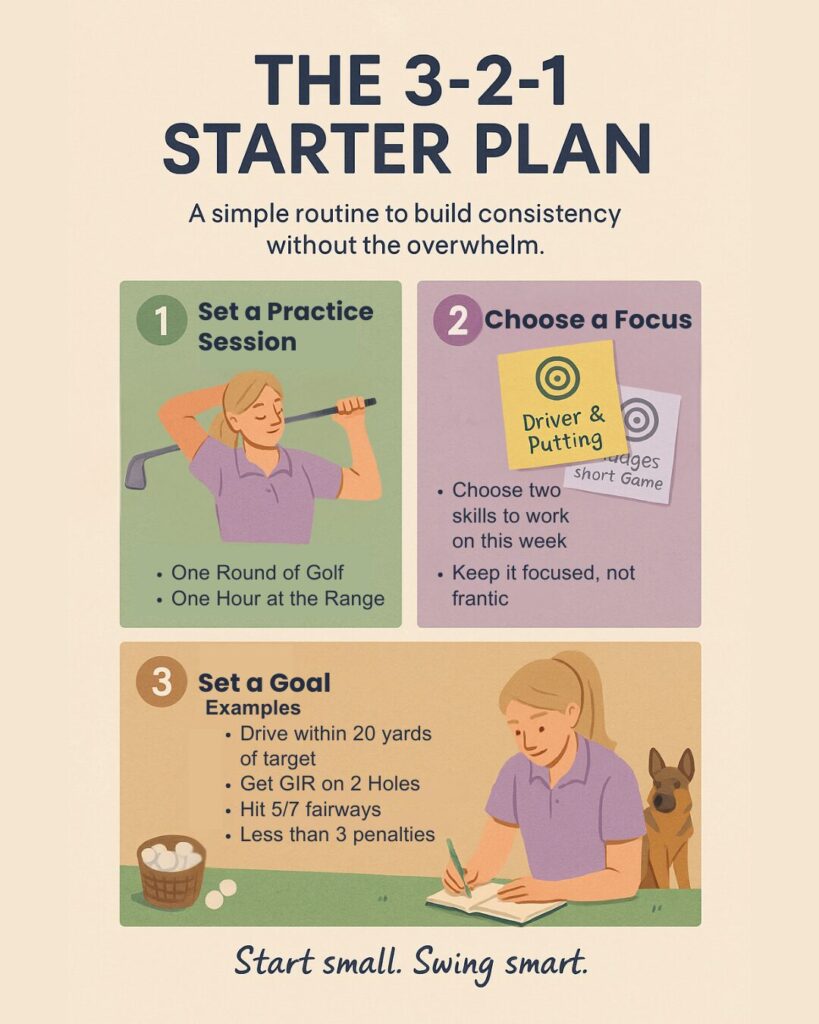
🧩 New Here? Try the 1-2-3 Starter Plan
If the full loop feels like too much right now, start small. This rhythm isn’t all-or-nothing — it’s scalable. That’s where the 1-2-3 Starter Plan comes in:
- 1 Goal: Choose one thing to focus on this month — maybe it’s reducing penalties, improving your aim, or getting more confident inside 50 yards.
- 2 Practice Sessions: Pick two days a week for focused work. They don’t need to be long — 30–60 structured minutes makes a difference.
- 3 Rounds: Play three rounds this month. Not every round has to count for score. Think of one as a test, one as rehearsal, and one just for joy.
I used this format during my first month back. It gave me structure without pressure — and momentum without burnout. If you’re just getting started (or restarting), this is the perfect way to build your own improvement loop.
Final Thought
If you’re chasing a scoring goal — whether it’s breaking 100, 90, or just playing better with friends — you don’t need more time. You need a better rhythm.
One that you actually look forward to. One that helps you see results.
This is mine.
What will yours look like?
