
G — Game Plan
G starts before you get to the course.
I’ve been using DECADE Foundations to think through tee shot strategy ahead of time — which holes punish a miss left, where the safe miss lives, what the actual target is rather than the optimistic one. UMGC is the right testing ground because it’s a course I know well enough to actually plan. More on DECADE in the offseason once I’ve finished a season with it.
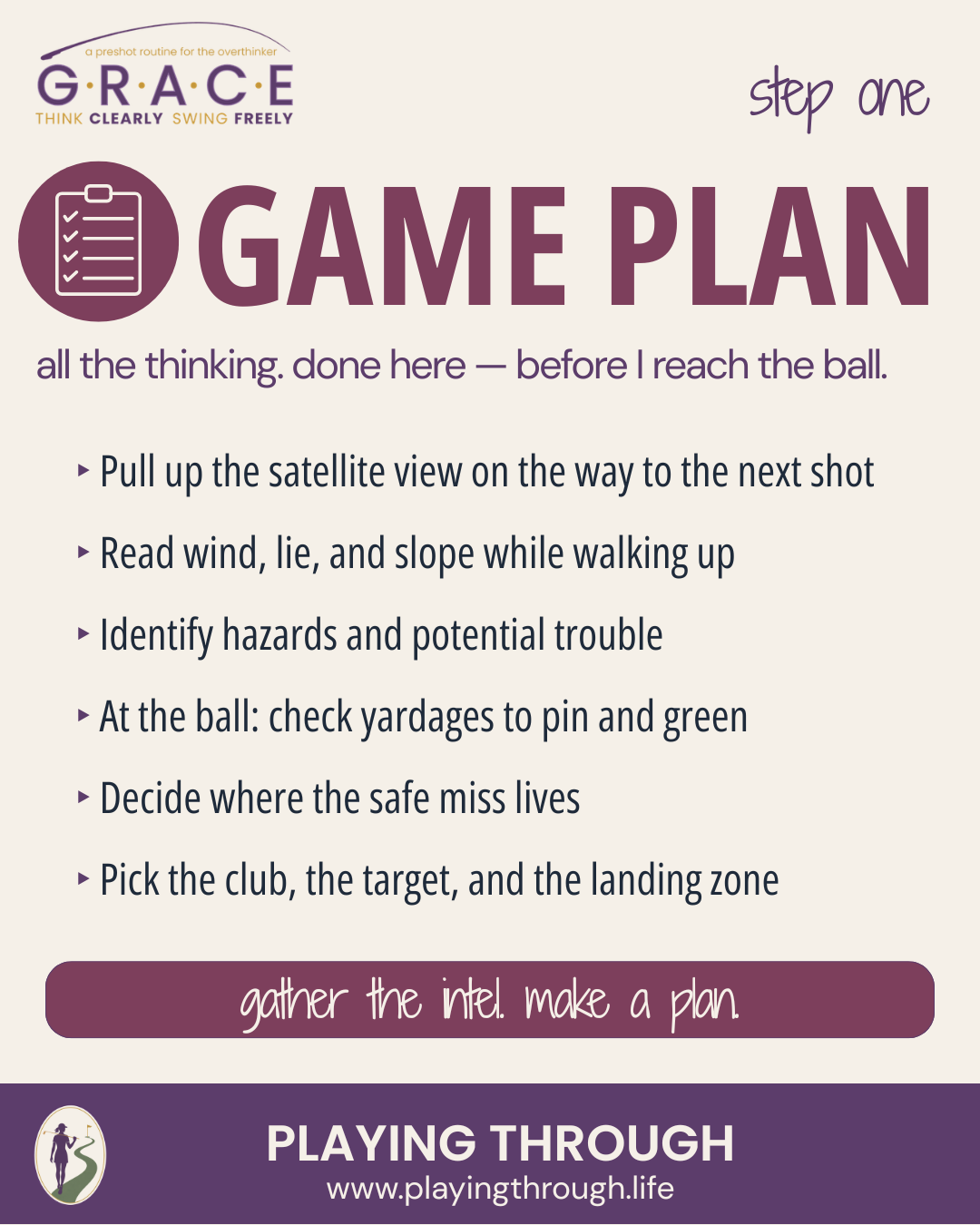
On the course, G picks up the moment the post-shot routine closes. “See it, say it, save it, shift” ends the last shot — G opens the file on the next one. Before leaving the cart or tee box, pull up the satellite view on 18Birdies and read the hole from above: landing zones, hazards, where the trouble actually is versus where it looks like it is. Then in transit — walking or riding — note the wind direction, the lie quality if you can see it, and any slope you’re walking through. When the lie is uncertain, bring two clubs. It keeps you moving and keeps your brain from crowding when you get there.
Starting G in transit also helps me stay intentional about input. I tend to think out loud, and I’ve learned that contemplation pauses can invite opinions — which isn’t always unwelcome. Sometimes I want a playing partner’s read on the wind or the line, and I’ll ask. The difference is whether I’m choosing to invite that conversation or just drifting into it because I haven’t done my thinking yet. Arriving with a plan means any input I get is additive rather than substituting for my own process.
At the ball: check yardages — ideal landing zone, any hazards to carry, front, mid, and back of the green. Confirm the club, adjust for anything the lie or wind changed, and close G out. Then R opens.
R — Rehearse
R is where the mental picture gets built — and where I’ve learned that the picture itself is doing more work than I used to give it credit for.
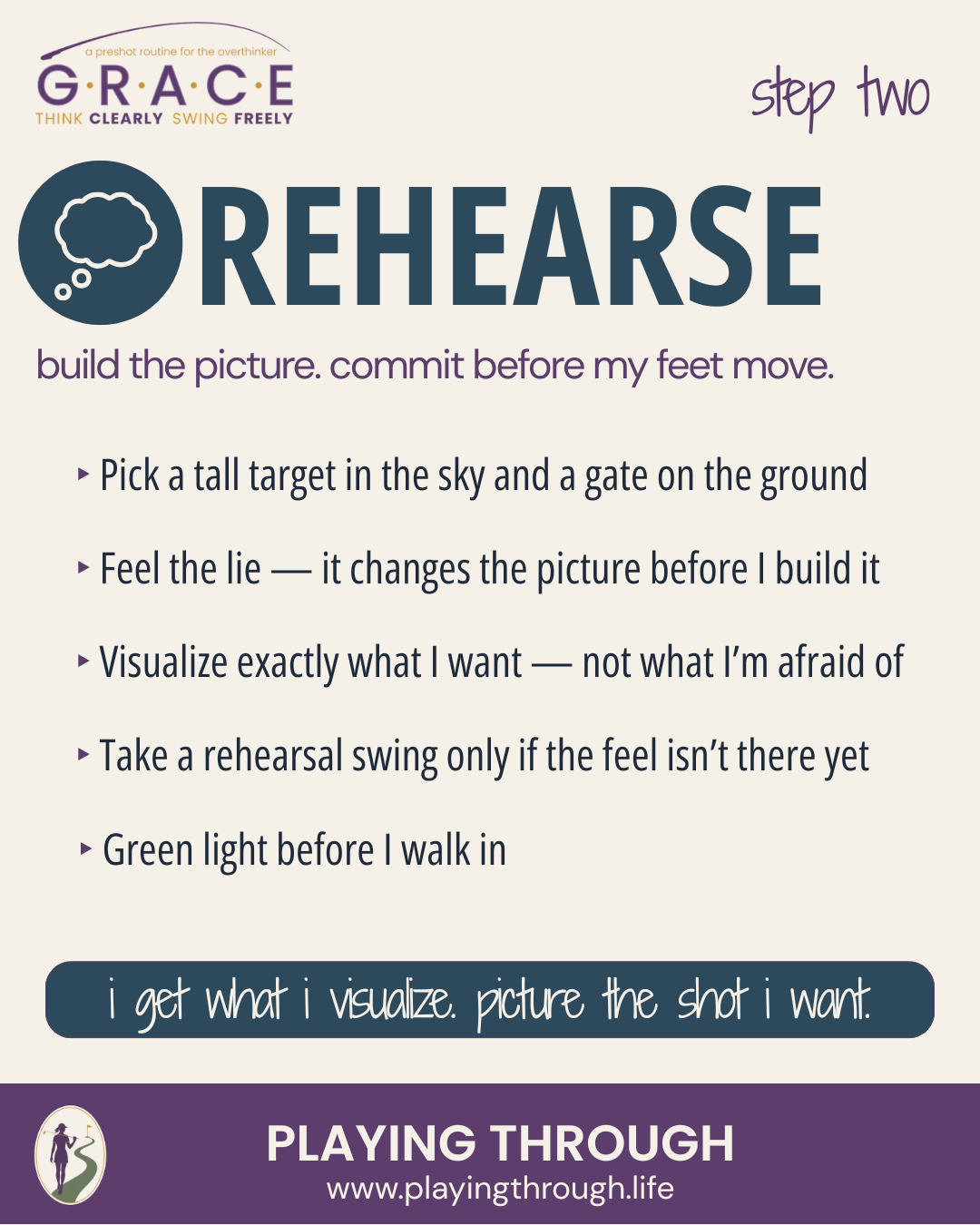
The sequence starts behind the ball. Pick a tall target in the sky — something specific and visible, a treetop, a roofline, a point on the horizon that I can fix from behind the ball and still find when I step in beside it. Then pick an intermediate target or gate on the ground: one or two points between the ball and the target that the ball needs to pass through. A gate is often easier to aim through than a single distant point — two references give the mind something to thread rather than chase.
For tee shots: place the ball, align the lines on it to the gate, step back and verify the picture is right before stepping in. For approach shots: feel the lie first — is it uphill or downhill, are my feet above or below the ball? Those answers adjust the target line and alignment before I build the picture, because the lie influences both direction and height whether I account for it or not.
Then, if needed, a rehearsal swing. Not always — if the feel is already there I skip it. When I do take one, it’s doing specific work: rehearsing face closure, feeling the weight shift and timing, or getting the sensation of the connected turn with the left arm straight and the right arm close. It’s not a warmup waggle. It’s a feel I’m looking for.
Then the visualization. I’ve learned — when I was frustrated by producing hooks while trying to straighten out a slice and my instructor told me that was exactly what I wanted, later confirmed by Sherman’s fight-fire-with-fire method — that picturing a specific ball flight actually influences the outcome without requiring me to think about the mechanics to produce it. That’s how I discovered it works: visualizing the opposite of the flight I was trying to avoid would move the ball, sometimes too far in the other direction. The on-course application is the positive version. Picture exactly what you want — the ball starting at the tall target, passing through the gate, landing where Game Plan decided. You get what you visualize, so visualize the shot you actually want, not a correction of the one you’re afraid of. It’s why aiming left to play the slice reliably produces the most aggressively straight shot you’ve hit all day, usually into whatever you were trying to avoid on the left.
When that picture locks, commit. When it doesn’t, stay here until it does — or reset and start R again. Green light before the feet move.
A — Approach
A is the body confirming what the mind already decided. The decision is made. This is the physical execution of it — a sequence of cues built up over a full year of swing shifts, one mechanic at a time. I didn’t design this list. It accumulated. And when something feels off in my swing, this is where I return — working my way up from feet to head until I find what’s missing.
Every time:
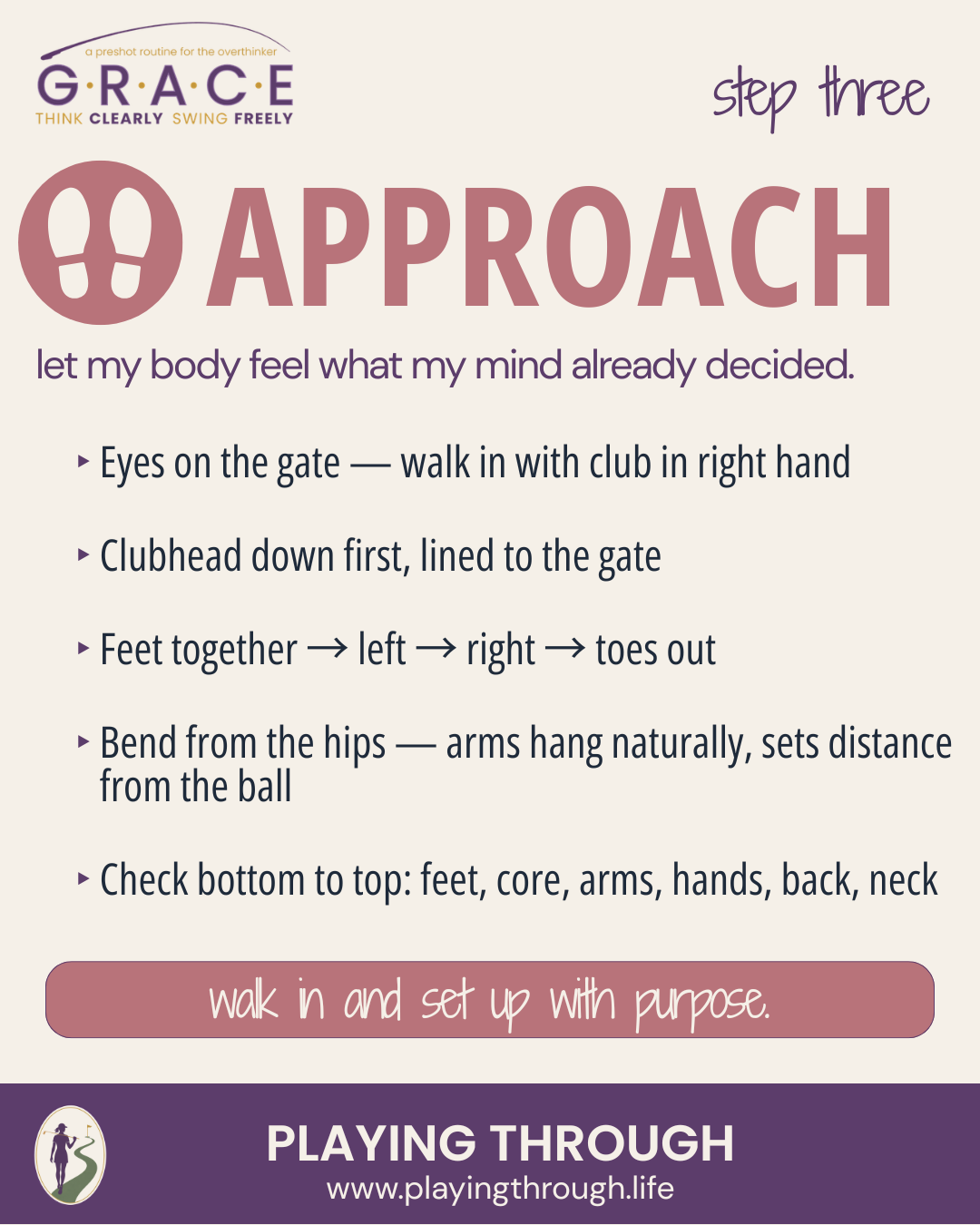
- Eyes on the gate — walk in with the club in the right hand, eyes fixed on the intermediate target. Clubhead down first, lined to the gate, an inch or two behind the ball.
- Feet together — ball centered, both feet together first.
- Hips — bend from the hips, not the waist. Arms hang naturally — this sets the distance from the ball. Spine angle checked here.
- Left foot, right foot — left foot steps out into position for the club, then right foot.
- Toes — turn toes out to give the hips room to turn freely.
Preflight body check (a few targeted beats if I know what’s been off, or full bottom to top when needed):
- Feet — front to back balance, lean wiggle to get the feeling right.
- Core — press down from the left hip into the ground, then the right, feeling the weight shift side to side. Sometimes a small hip rotation too — practicing that independence from the shoulders and upper trunk before the swing starts.
- Arms — straight but not tense.
- Boobs — tucked in. I bring them with me when I swing, since the whole upper body is turning together — but sometimes they have a mind of their own and it throws everything off. Consider this a legitimate preflight check.
- Hands — set the grip. Shake out fingers and forearms until the tension actually leaves, not just until I’ve gone through the motion.
- Back — straight, shoulders slightly rounded, shoulder blades pulled back not hunched.
- Neck — quick side to side. Tension release and head position.
Every time to close:
- Target → ball — one look at the target, one look at the ball. Club-specific: irons, just in front of the ball; woods, at the ball; driver, ground just in front for lowpoint control.
- Clubhead — place it in final position relative to the ball. Then C opens.
G.A.P.S. at a glance
> > G.A.P.S. — grip, alignment, posture, stance — was a framework I picked up from an instructor early in year one. It was a useful mnemonic when I needed a simple entry point into setup. Over time I found my own bottom-to-top sequence works better as a diagnostic: feet → core → arms → hands → back → neck. G.A.P.S. is still the right shorthand for what A is doing. It’s just not how I run the check anymore. > > Grip — neutral, light pressure. Toothpaste rule: firm enough to hold it, not so tight you’d squeeze the tube. > Alignment — clubface to gate first, body square to that line. > Posture — hips, spine, arms, shoulders, neck. Physical cues not swing thoughts. When something feels off, work bottom to top: feet → core → arms → hands → back → neck. > Stance — feet together → left → right → toes out.
C — Center
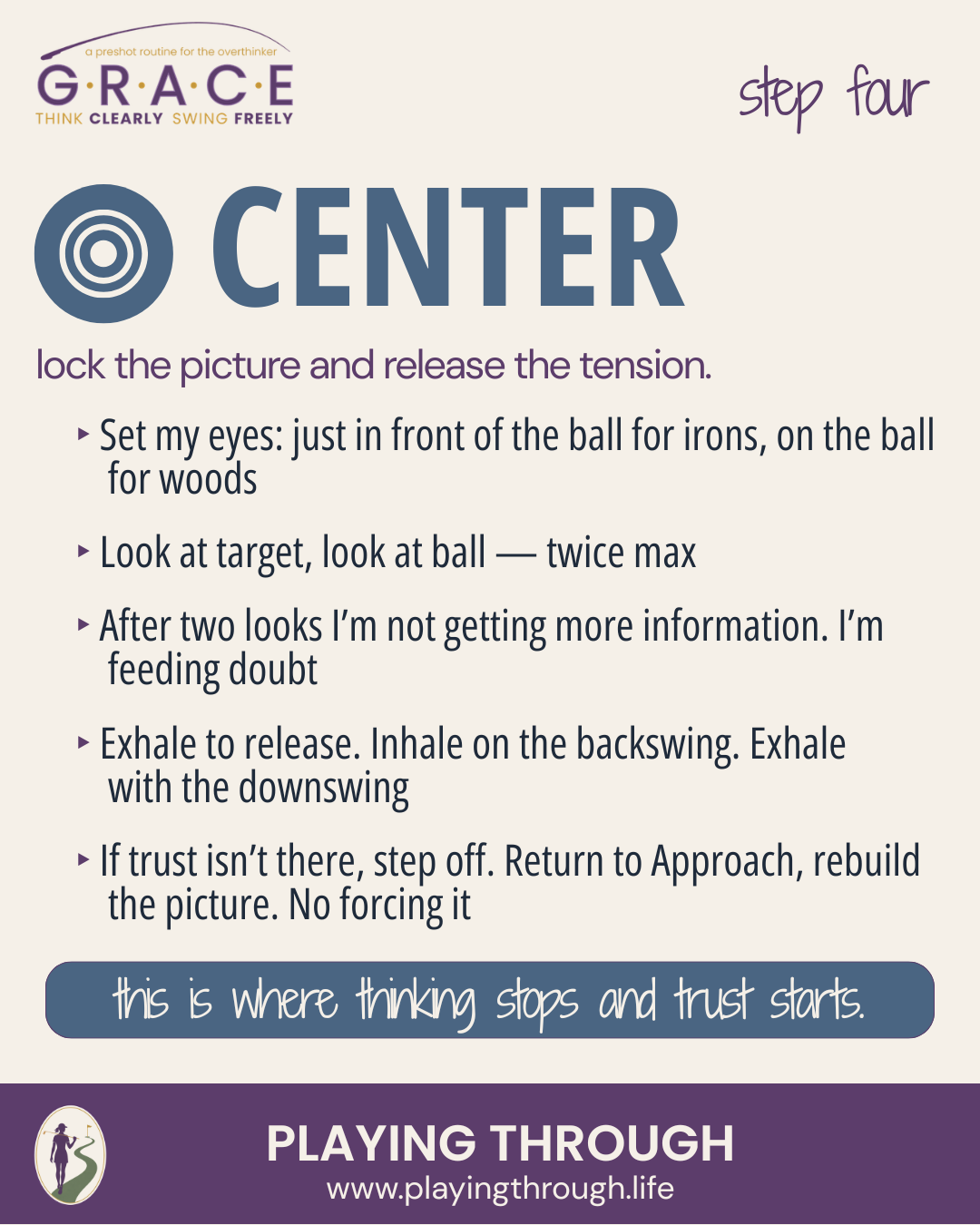
C is the fastest step — usually tied with Execute for the shortest phase in the whole routine. It’s not a checklist. It’s a feeling. When it’s right, I know it. When it isn’t, the two-look cap keeps me from spiraling.
Set my eyes first — just in front of the ball for irons, on the ball for woods, just behind it for driver. Low point control is a key focus this year, and where I set my eyes is a direct input into that. Then: look at the target, look back at the ball. Repeat if needed — but no more than twice. After two looks I’m not getting more information. I’m feeding doubt.
The breath sequence runs through C. One exhale first — release the tension, land in the body, signal readiness. That’s the reset breath, the one that closes the door on everything that happened in Approach and opens it for Execute. Then the inhale starts the backswing, and the exhale comes with the downswing. Three breaths, three distinct jobs. The gap between the C exhale and the first movement is where tension sneaks back in — the exhale should connect almost directly into the first motion.
When the picture locks: inhale, backswing goes.
When it won’t lock after two looks: step off. It doesn’t happen often — but when the overthinking loop starts, the only way to break it is to physically break the setup. Walk a small circle, fix your eyes on the target and the intermediate gate to re-establish the picture, then back to Approach. That’s not a failure. That’s the routine working.
E — Execute
Finish it.
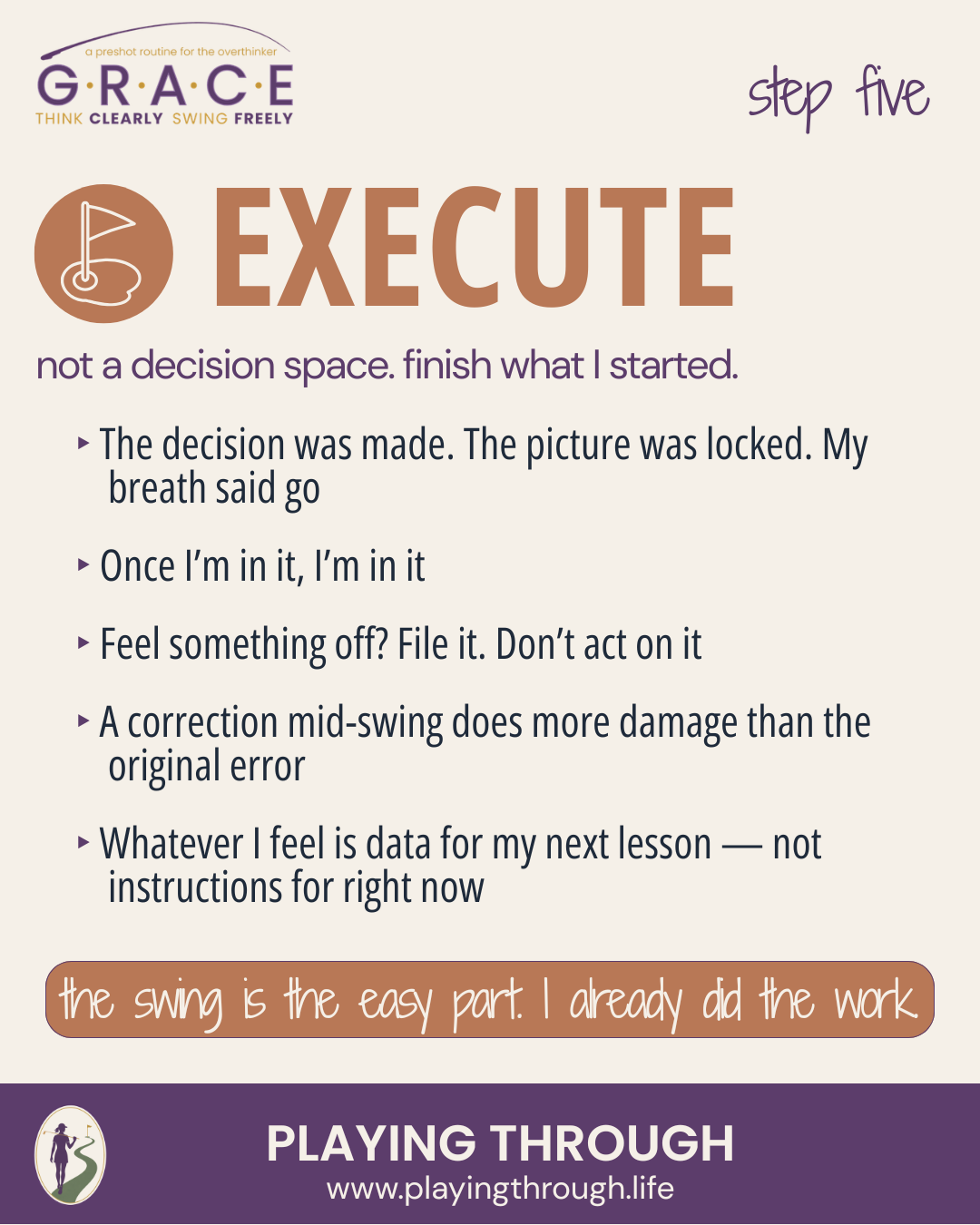
E is not a decision space. I set the game plan in Game Plan — no second guessing that now. The shot was decided in Rehearse. Setup locked in Approach. Picture locked and commitment settled in Center — and my breath told me I was ready. Everything that needed to happen has happened. This is just the swing.
Once I’m in it, I’m in it. Sometimes I can feel something go sideways in the backswing — arms went up, tempo broke, whatever. The correct response is nothing. The swing that started is the swing that finishes. A slightly off backswing produces a manageable miss. A slightly off backswing plus a mid-sequence correction produces something genuinely ugly, because now there are two variables on top of each other with no time to process either one.
Whatever I feel in the backswing is information for my post-shot routine, or to bring to my instructor later — not instructions for right now. I file it, finish the swing, and ask about it at the next lesson.
Overcorrections do more damage than the original error. Finish it.
The reset map
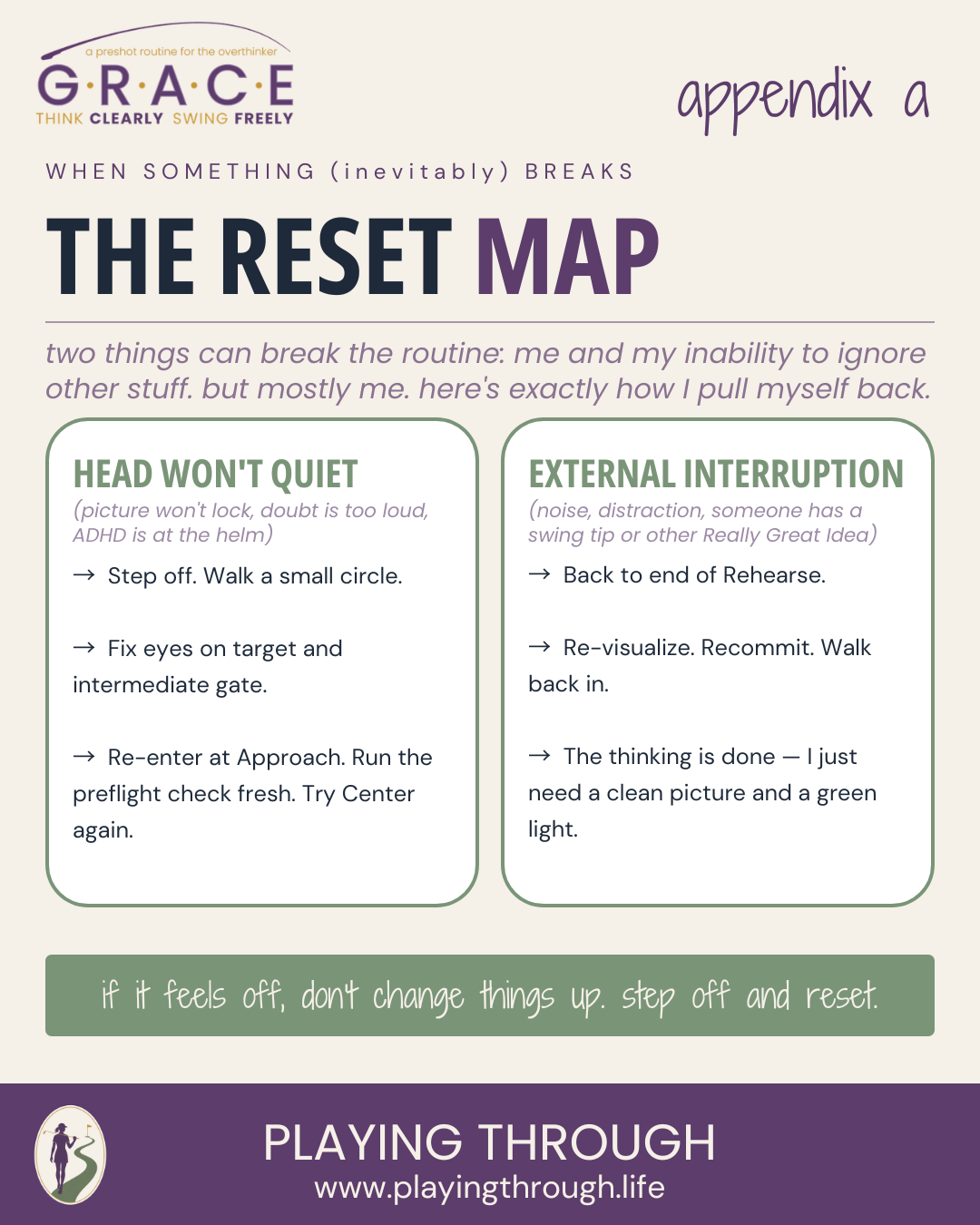
The original framework didn’t have an explicit reset protocol. When something broke mid-routine, I’d either push through compromised or improvise, and improvising under pressure is not a reliable system.
The 2026 version has two defined reset triggers with two different re-entry points:
External interruption (noise, distraction, someone talks mid-setup): back to the end of Rehearse. Re-visualize, re-rehearse, recommit. The thinking is done — you don’t need to go back to Game Plan. You just need a clean picture and a green light before walking in again.
Head won’t quiet in Center (picture won’t lock, doubt is too loud after two looks): step off. Walk a small circle, fix your eyes on the target and the intermediate gate, then re-enter at Approach. Run the preflight check fresh. Try Center again.
Two different triggers. Two different re-entry points. Both are normal. Neither is failure.
The breath sequence
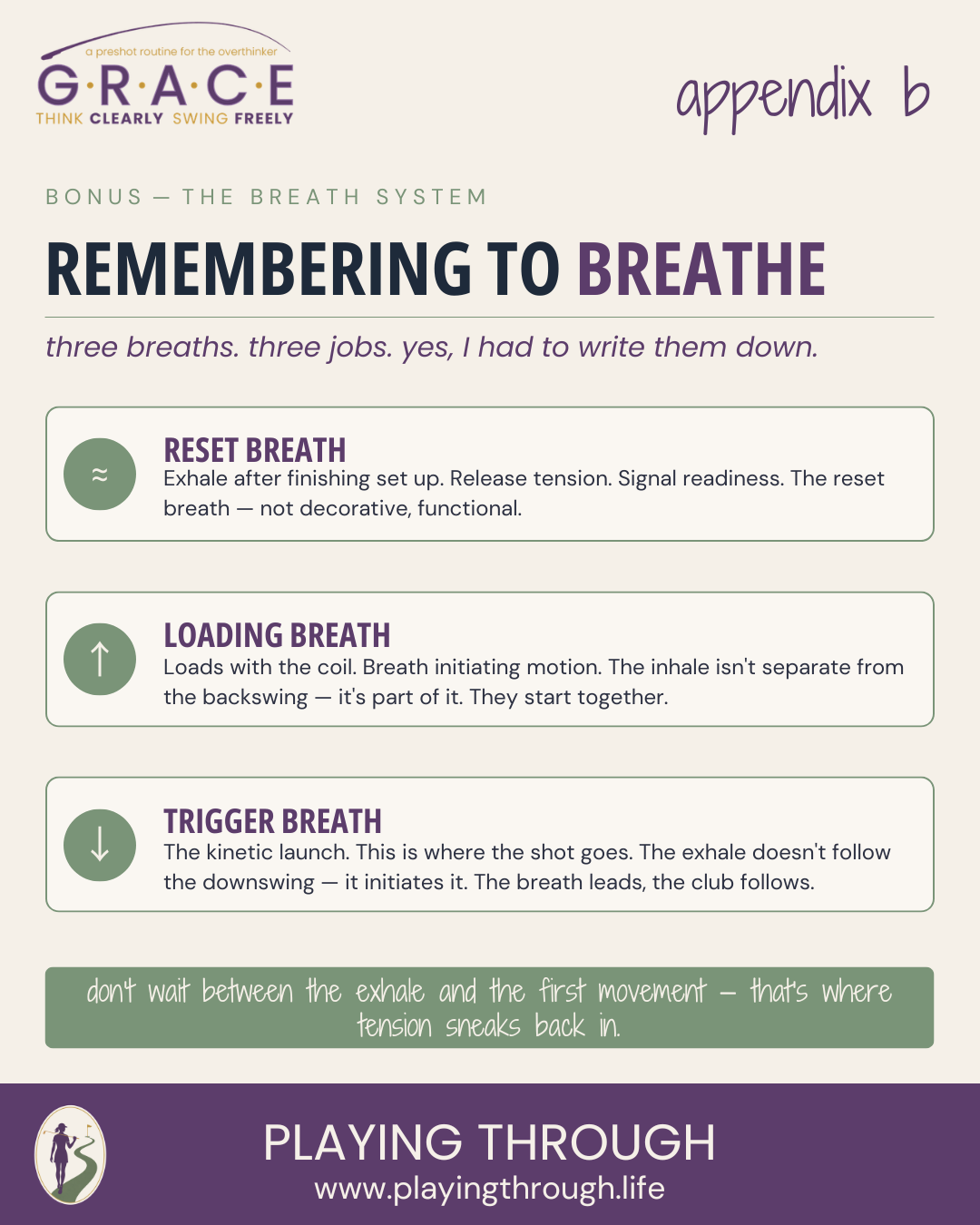
Three breaths. Three jobs. None of them are “just relax.”
The exhale in Center releases tension and signals readiness — the reset breath, the one that lands you in your body before the swing starts. The inhale on the backswing loads naturally with the coil; breath and body move together. The exhale on the downswing is the kinetic trigger — that’s where the shot actually goes.
The Center exhale and the downswing exhale are doing completely different things. One is preparatory, one is athletic. Both belong. The only thing to watch is the gap between the Center exhale and the first movement of the takeaway — if that pause gets long, tension creeps back in. The exhale should connect almost directly into the first motion.
What this is not
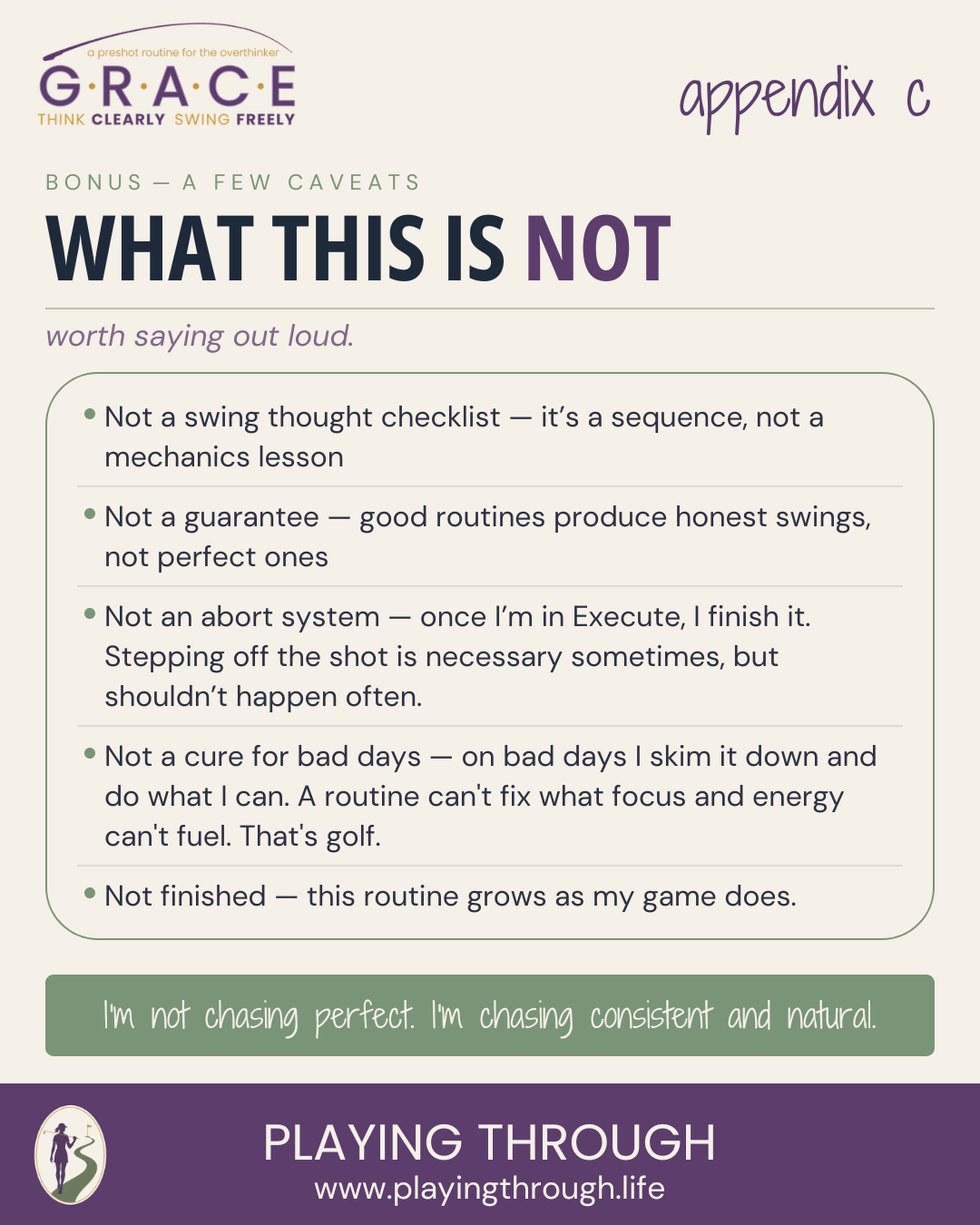
GRACE is not a swing thought checklist. Each letter is a phase with a job — not a mechanical cue, not a reminder to check your wrists.
It’s not a guarantee. Good routines produce honest swings, not perfect ones. Some days Center takes three attempts. Some days the picture just won’t lock. That’s golf, not a failure of the system.
It’s not an abort system. Once you’re in Execute, you finish it — no mid-swing edits. Stepping off the shot is sometimes necessary, but it shouldn’t be a habit.
It’s not a cure for bad days. On bad days I skim it down and do what I can. A routine can’t fix what focus and energy can’t fuel. That’s just golf.
And it’s not finished. This routine grows as my game does. I’m not chasing perfect. I’m chasing consistent and natural.
A note on putting
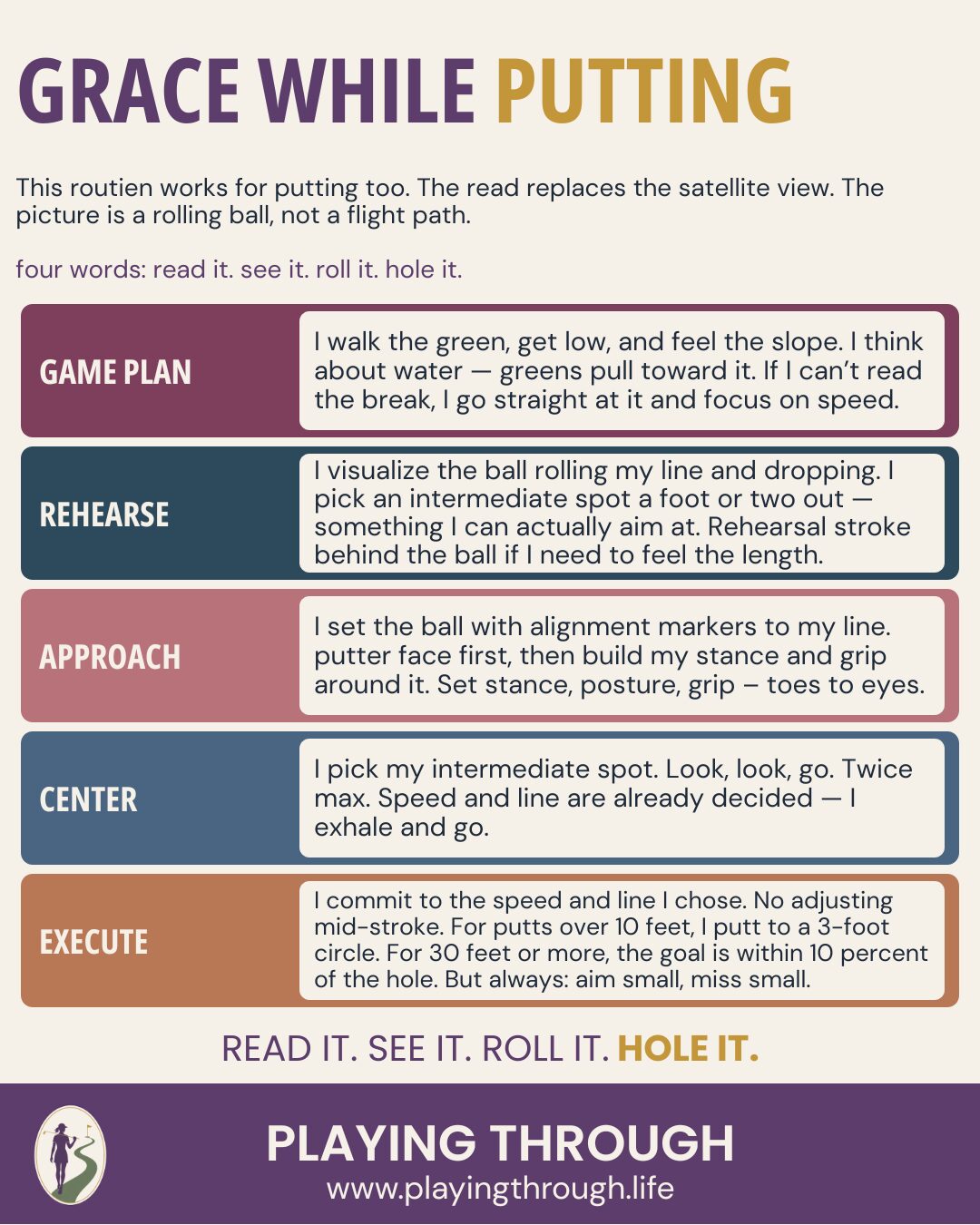
GRACE applies to putting too — the same five phases, the same commitment gate in Rehearse, the same two-look cap in Center, the same “finish it” in Execute. But Game Plan and Approach are different enough that they deserve their own treatment.
Game Plan on the green is a full read: walking the perimeter, getting low behind the ball, feeling the slope under your feet, watching how other putts break. It’s slower and more deliberate than pulling up a satellite view — the information is physical, not digital. Target selection becomes line selection, and the visualization in Rehearse is a ball rolling along a curve rather than a flight through the air.
Setup and body posture are also meaningfully different. A full putting breakdown is coming later in this series.
Built to scale
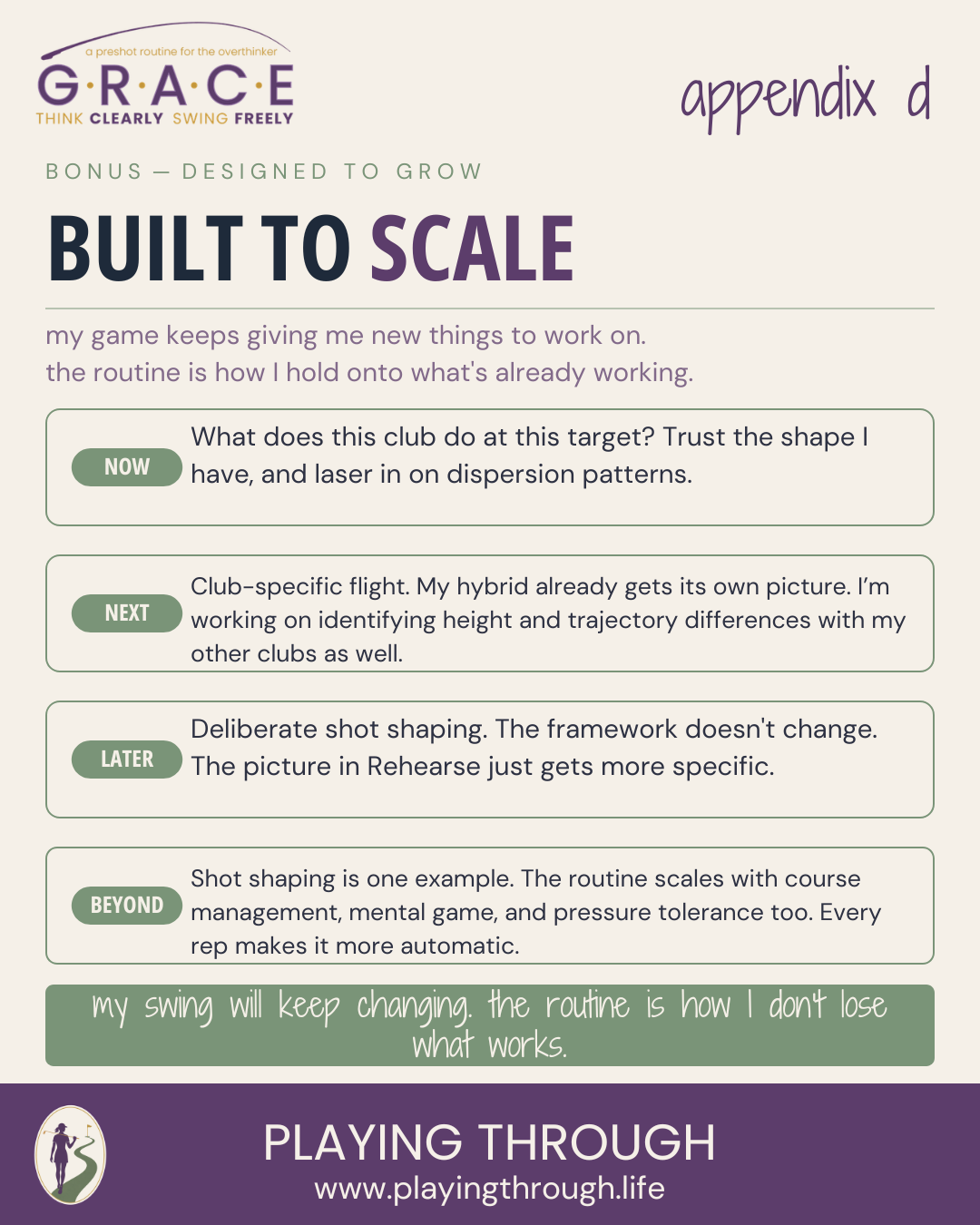
The shot shaping step in Rehearse was built in intentionally, for when the game gets there. My game keeps giving me new things to work on. The routine is how I hold onto what’s already working.
Right now, the visualization means: what does this club do at this target? Trust the shape I have, and laser in on dispersion patterns. That’s honest. You train the picture before you train the shape.
The progression is already happening — the hybrid gets its own picture, and I’m working on identifying height and trajectory differences with my other clubs. Next comes club-specific flight across the whole bag. After that, deliberate shot shaping — the framework doesn’t change, the picture in Rehearse just gets more specific.
And beyond that: shot shaping is one example. The routine scales with course management, mental game, and pressure tolerance too. Every rep makes it more automatic.
My swing will keep changing. The routine is how I don’t lose what works.
What’s next in this series
GRACE is one piece of a larger picture I’ve been building out this season. If the routine is the how — the sequence that gets me from standing behind the ball to finishing a committed swing — the rest of the series is about the why and the what else.
- Why I built a pre-shot routine — the origin story, and the questions worth asking yourself before you build your own. (Post 2)
- What the research actually says — the European Tour data, Scott Fawcett’s DECADE system, Jon Sherman’s Four Foundations, and what the science says about why routines work at all. (Post 3)
- What Tiger, Annika, Rory, and Nelly do — four players I’ve watched more than any others, which means I actually have something to draw from. Annika was who I watched as a teenager first falling in love with the game — some of those habits lingered longer than I realized. (Post 4)
- One season in — what held up, what broke, and what the 2026 version of GRACE looks like under league pressure. (Post 5)
Links will populate as posts go live.
Leagues started two weeks ago. First real test of the 2026 version under conditions that actually matter — different courses, unfamiliar holes, other people watching. The refinements are holding. The commitment gate in Rehearse is doing exactly what it was supposed to do.
More data incoming.