

There’s a specific round burned into my memory from the end of last season.
Nine holes at Fellows Creek, a Monday evening league round, late in the year. Forty-two strokes. Not exceptional golf — a few particularly beautiful shots, stayed in play the whole time, stuck some greens, converted some chips to one putts. I’d started the season just wanting to string together one complete hole. In this round, most of them were tidy. No doubles. No birdies. Simple, elegant golf that somehow added up to something.
The drive home I was just turning it over: that’s in there. That’s not luck. What would it take to play like that for eighteen holes, consistently, on purpose?
That question is what this plan is built around.
The Honest Starting Point
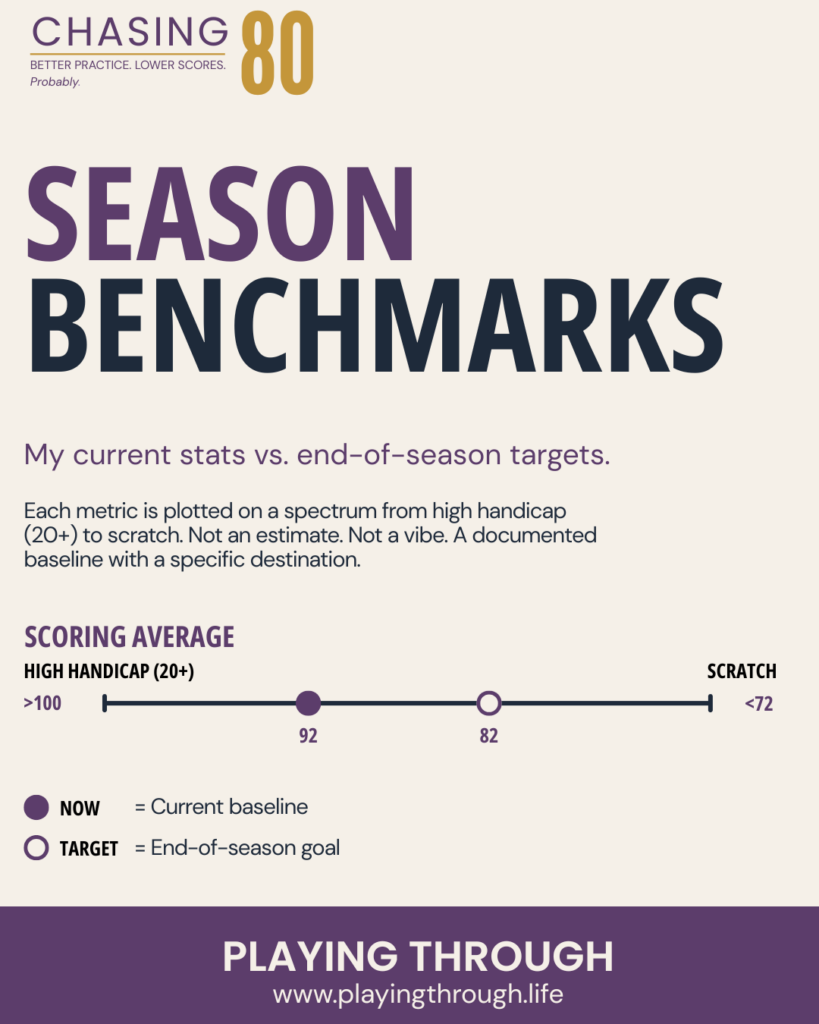
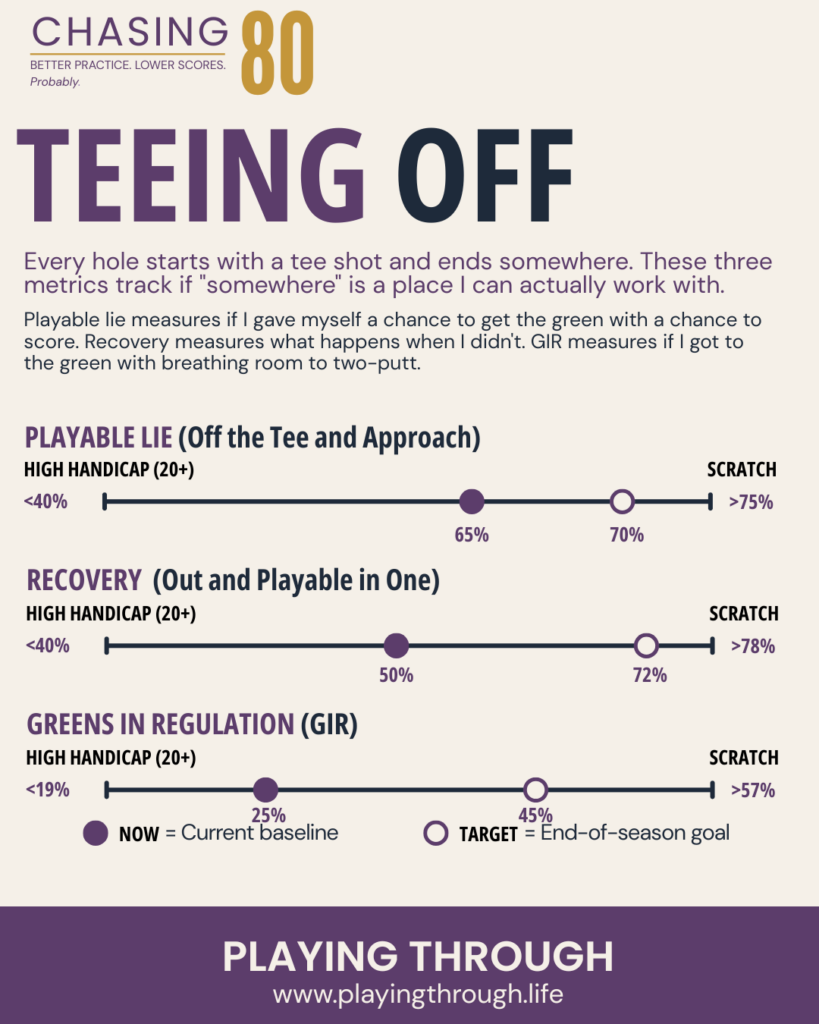
The strokes gained data from 2025 tells a story I’ve looked at enough times that I’ve stopped being surprised by it. Tee and approach are genuine strengths — I’m getting the ball to the green in regulation more often than my handicap would predict. My 7-iron carries 137 yards. My driver averages 190. Those aren’t beginner numbers.
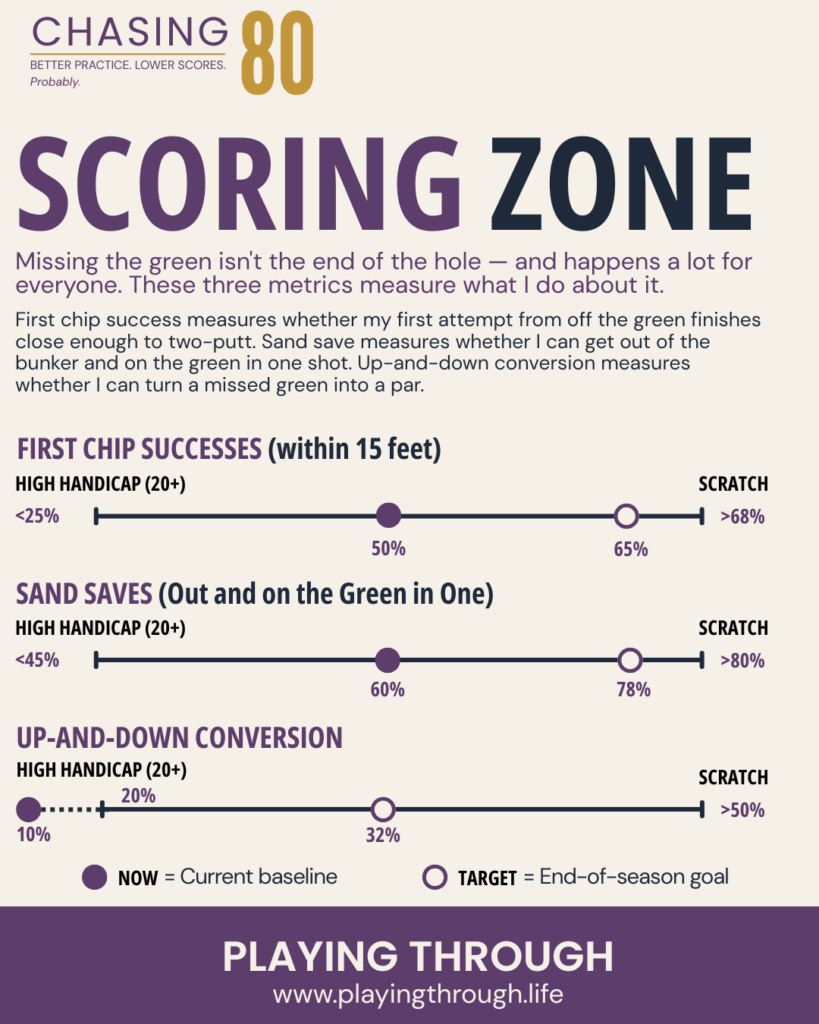
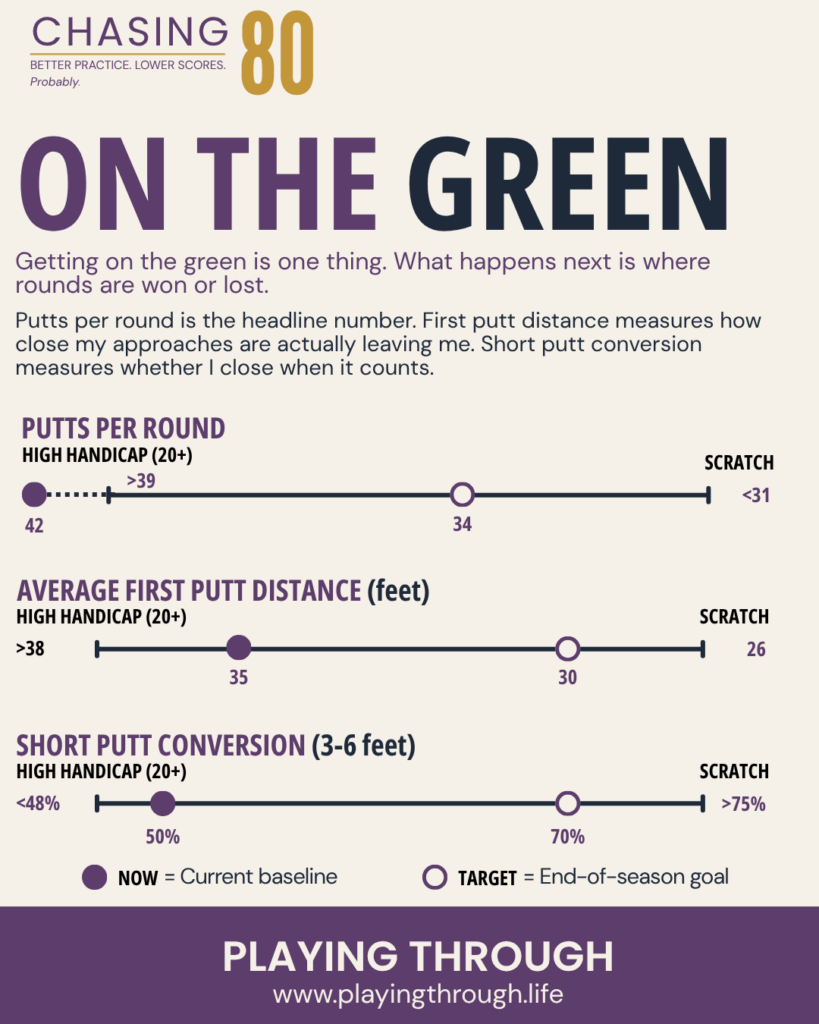
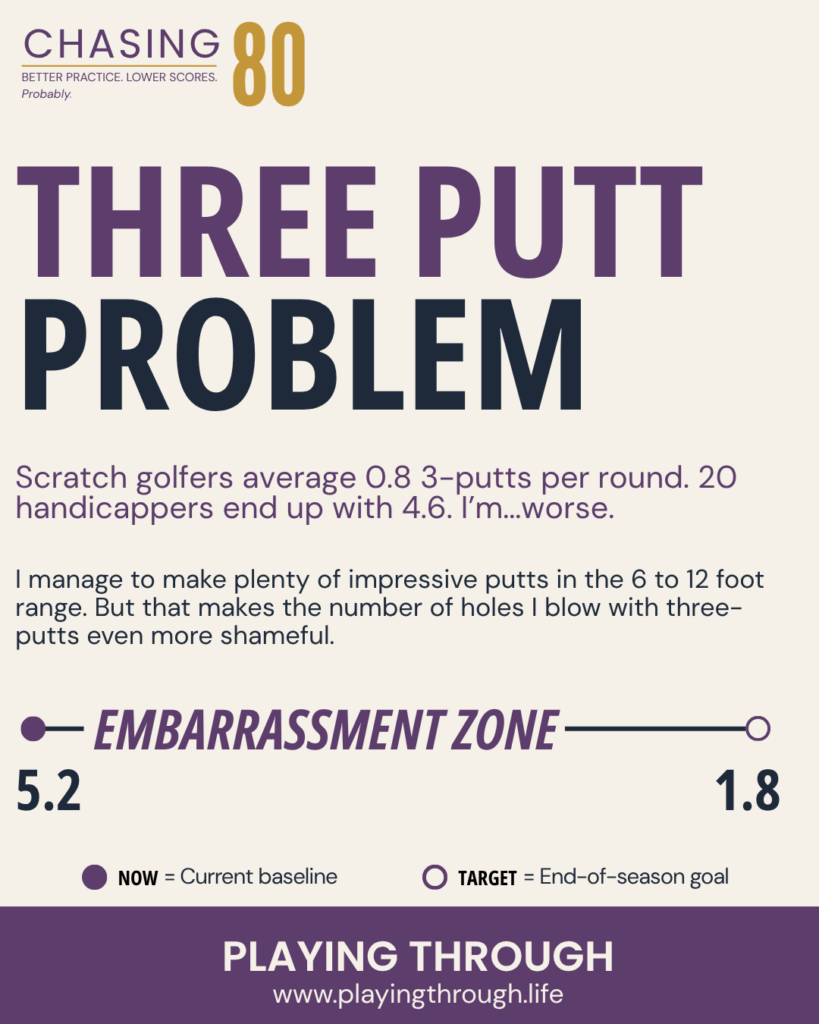
The around-the-green bar on that same chart is the tallest one. Thirty-nine putts per eighteen-hole round. Up-and-down conversion under 10%. A three-putt rate that should embarrass me into practicing putting every single day. (It did. That’s now the plan.)
The gap between how I’m hitting it and how I’m scoring isn’t a mystery anymore. The data located it precisely: everything inside 100 yards, and what happens between my ears when the pressure is on. Those are fixable. That’s the work.
What Golf Actually Is
Here’s the thing I kept coming back to while building this plan. At the end of the day, golf is one thing: club meets ball. That’s the whole game. It sounds obvious when you say it out loud — and I’m not sure why it took me this long to actually think about it that way. I’ve been thinking about my backswing, my hip turn, my grip — all the machinery that exists to serve one moment that lasts less than a millisecond.
Once I saw it in my data, I couldn’t unsee it anywhere.
Four symptoms. One root cause. The kind of thing that looks like four separate problems until you pull back far enough to see the pattern, and then it’s obvious that you’ve been solving the wrong thing.
The putting piece is worth separating out, because the mechanism is different. The fitting means I have the right length for my height, I can aim more true and be more consistent at impact — but speed control is all me. That part isn’t fixed. I’m working with a coach this season to develop the face control that will get me to consistent distances and tighter dispersion across the whole bag. Same insight driving both — club meets ball, and how it meets ball is everything — different work.
I Have a 40-Page Plan and I’m Not Going to Subject You to All of It
The first rule of dating is don’t let all your crazy out at once. I’m assuming that extends to publishing things on the internet.
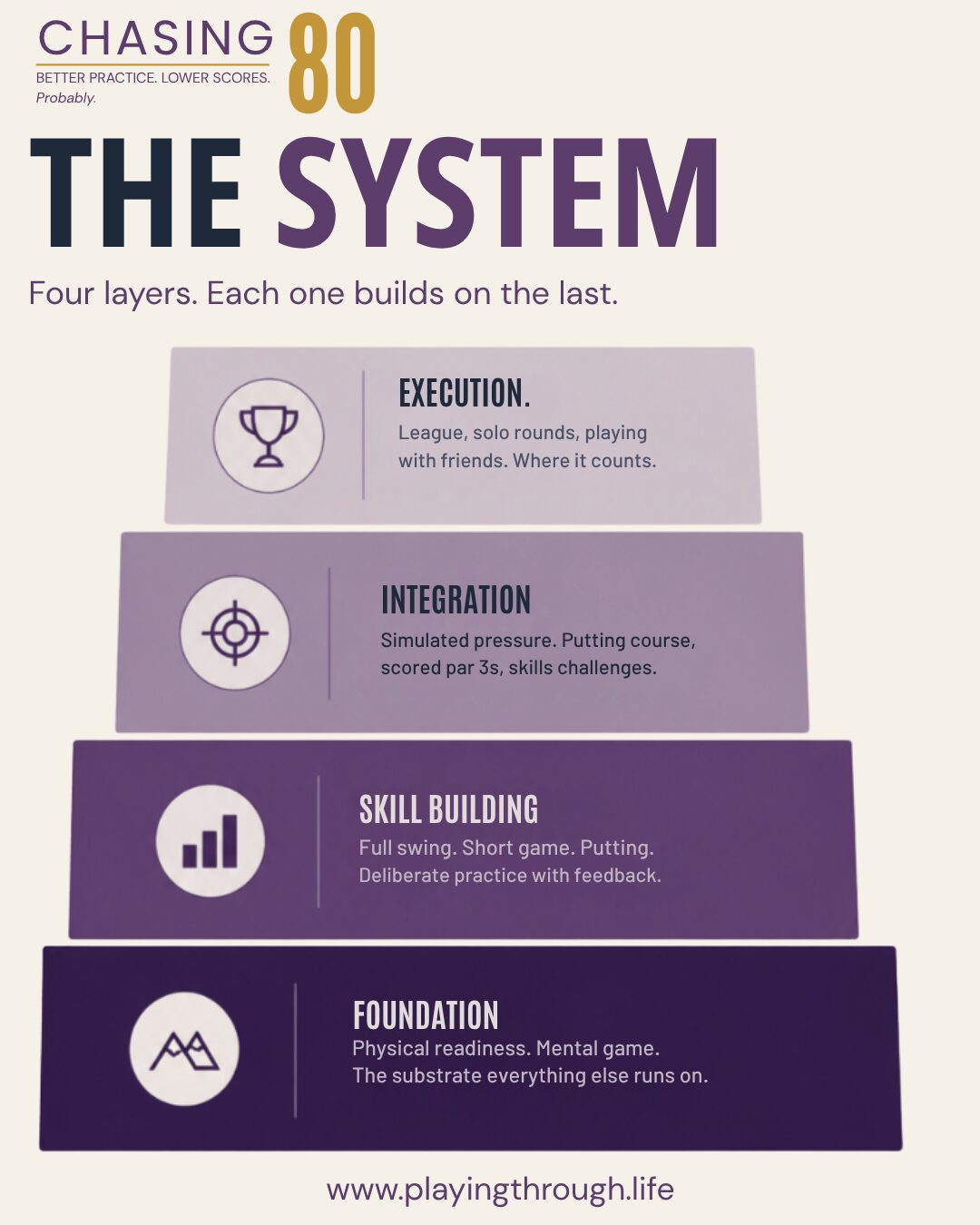
There are development pillars, practice tiers, skill tracking and assessment protocols, monthly reviews, goals, benchmarks, milestones, and what I can only describe as a critical path analysis. It’s a lot. I’m going to spare you the full prospectus — but I’ll be documenting how I work through it as it happens.
What the season looks like at a structural level: four phases. Pre-season runs through May 3 — pure foundation work, no league pressure, the goal is to walk into May 4 with routines running rather than scrambling. Phase 1 is May through June, when both leagues start and everything I’ve built gets its first real pressure test. Phase 2 is July and August — consolidation, skills moving from developing to owning. Phase 3 is September and October: execution mode, trust what’s been built, get to the finish line ready.
Competing before you’ve built something worth competing with is a pattern I’m specifically building the schedule to avoid.
Where the Practice Time Actually Goes
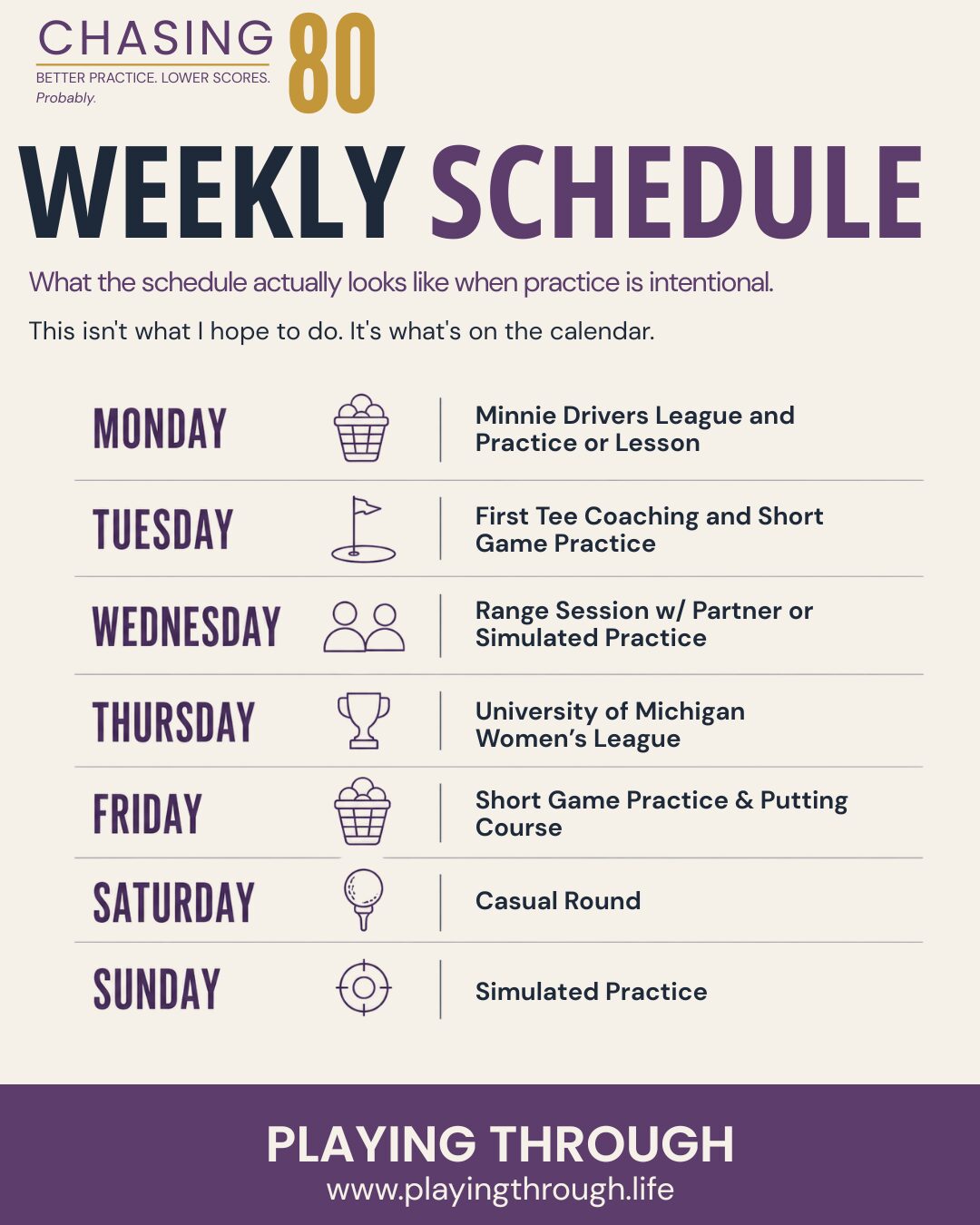
Most golfers spend the majority of their range time on full swings. And last season, despite my best intentions, so did I. I wanted to conquer that slice with the driver. And I ultimately tamed it — mostly straight or draws now, one mild slice every 12-15 hits. But even though I spent so much time practicing with it, I knew it wasn’t reliable on the course. So it spent more than its fair share sitting in the bag on timeout unless I was on the widest of fairways or the most obliging of dogleg rights. My 3-wood had an average carry of 15 yards less, but was considerably more likely to stay in the same zip code — let alone the same fairway.
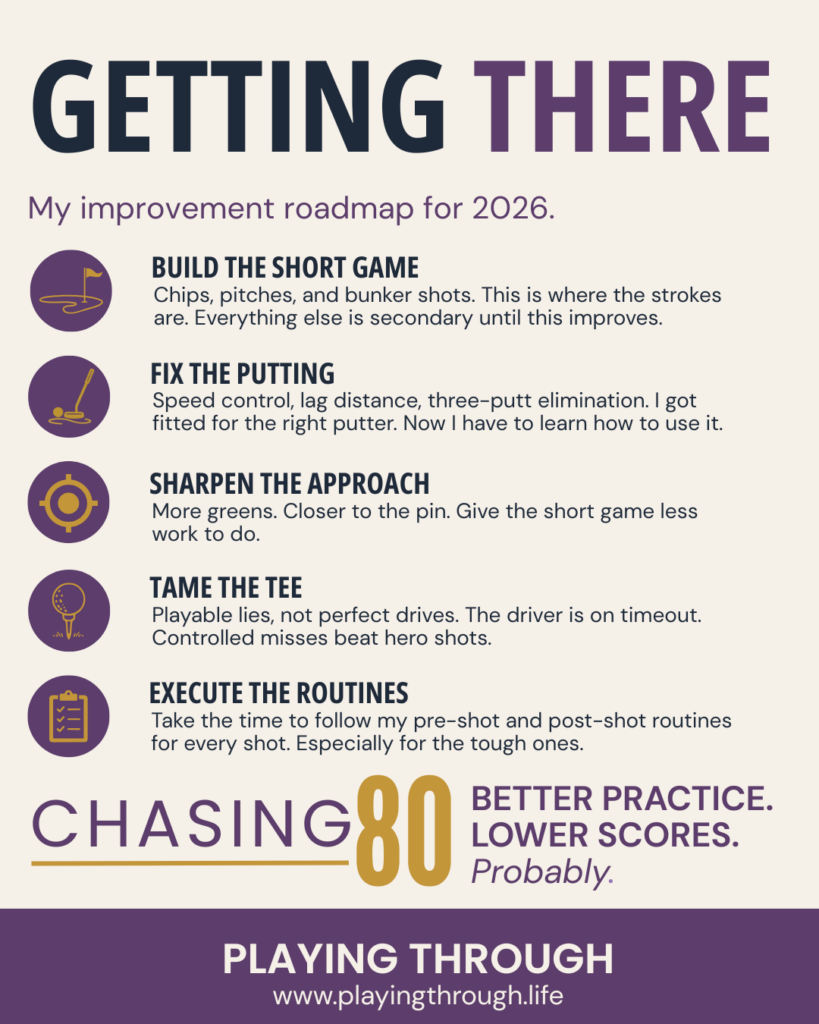
This plan is about keeping my intentions honorable — and honest. Short game is the priority.
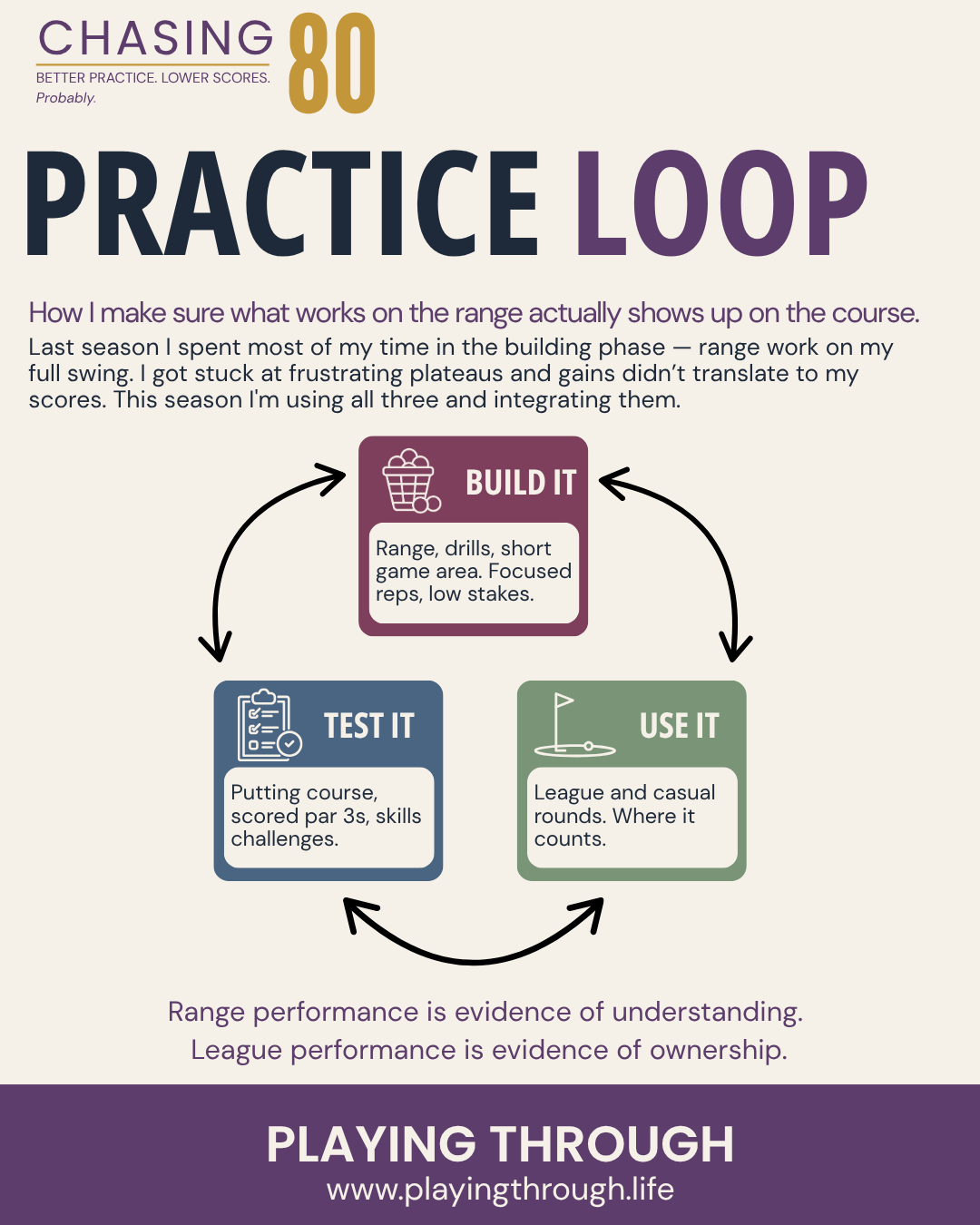
Every full practice session runs a 40/60/20 split: 40 minutes range, 60 minutes short game, 20 minutes putting. The logic is not complicated. The strokes are inside 100 yards. Practice time should go where the strokes are.
I spend 80% of my practice time inside 100 yards because that’s where my strokes are going. Spend more time on your short game is the most offered and least taken advice in recreational golf. Turns out the data agrees with it. Who knew.
Full swing work is grammar — foundational, always improvable, never fully mastered. Short game is vocabulary and style — it’s what you actually say, and why people should listen.
The Thing the Whole Season Builds Toward
In October, I’m playing 100 holes in a single day for First Tee Detroit.
Last year I did it for the first time — alternate shot with a partner, the two of us grinding through the full hundred together. It was a long, excellent, ridiculous day. I’m doing it again this year, format TBD.
That’s the big one. But October has other stakes too — Ian has enlisted me as a ringer for his company scramble, which is either a vote of confidence or a setup for a very awkward car ride home. And if the season goes the way I’m planning, there may be a few more rounds at Disney World courses to close it out.
The data will tell the story by then. But even if I can’t bring a sub-80 score to the scramble, I can at least bring the forward tees.
Progress, Not Perfection
The work didn’t start today. Pre-season has been running since March — routines built, equipment decisions made, the plan stress-tested before the first real round of the season. Showing up to May 4 ready rather than scrambling is the whole point of having a pre-season.
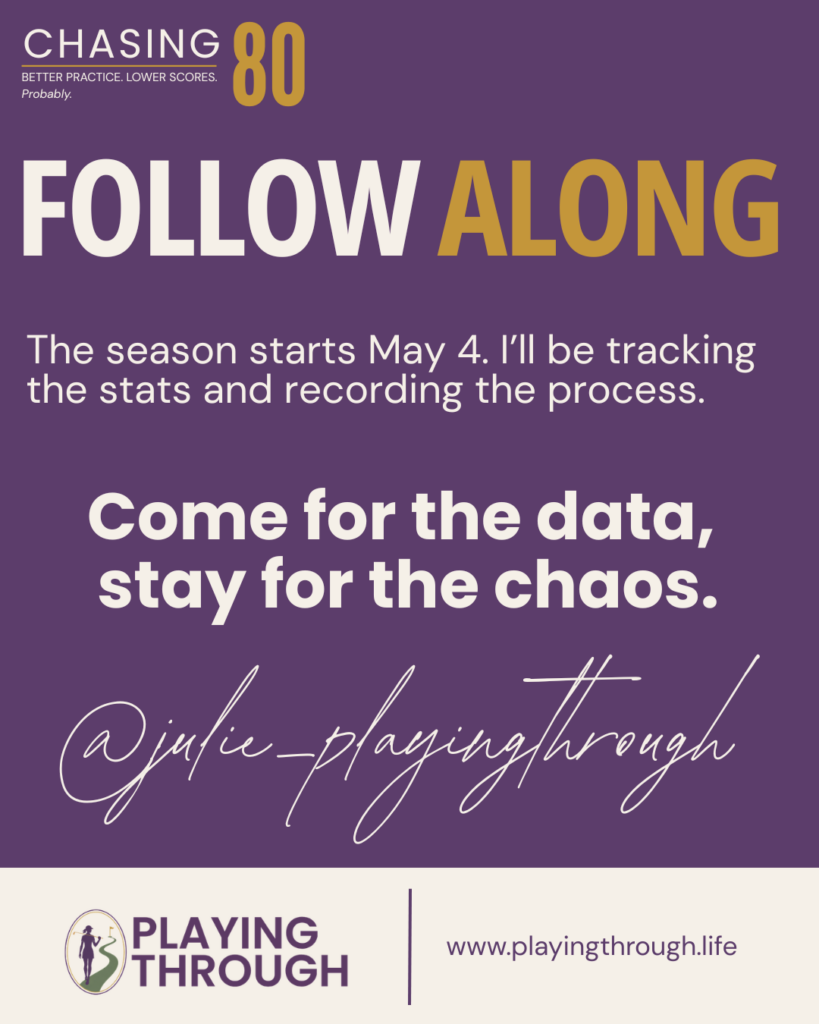
The blog is relaunching alongside it — and I’m going to start sharing content on social media too. As the snow started melting and I started itching to get outside, I found myself getting more and more golf content in my feeds — and being reminded why I started this in the first place. There’s a lot of inspiring content out there. There’s not nearly enough that speaks to golfers like me. So I’m making it for myself, and putting a lot of thought into it, with the goal of giving others a view into how you can enjoy the process of playing golf and developing your skills.
More on all of that soon. For now — league starts May 4, and the gap isn’t going to close itself.